
Your registration report describes the people who registered. It says much less about the person who could not use the form, could not find a language option, or decided the event would not support their participation.
That missing perspective matters when an event team discusses its “accessibility market opportunity.” A global population estimate cannot tell you how many people would attend your particular workshop. Nor can a caption connection prove that someone understood the presentation or will buy another ticket.
A better investment brief starts with the people you intend to serve, the tasks they need to complete, and the barriers you can observe. This guide helps you assemble that brief without inventing a growth forecast or making access depend on projected revenue.
Separate responsibilities from experiments
Maintain two planning tracks. One covers established access arrangements and applicable obligations, assessed through your organization's responsible process. The other investigates improvements and potential audiences. Do not withhold an agreed arrangement while waiting for a marketing experiment to establish its return.
For discovery, choose a specific audience and event: members attending a technical seminar, prospective students joining an open day, or employees participating in a regional briefing. “Everyone who needs accessibility” is too broad to guide a useful test.
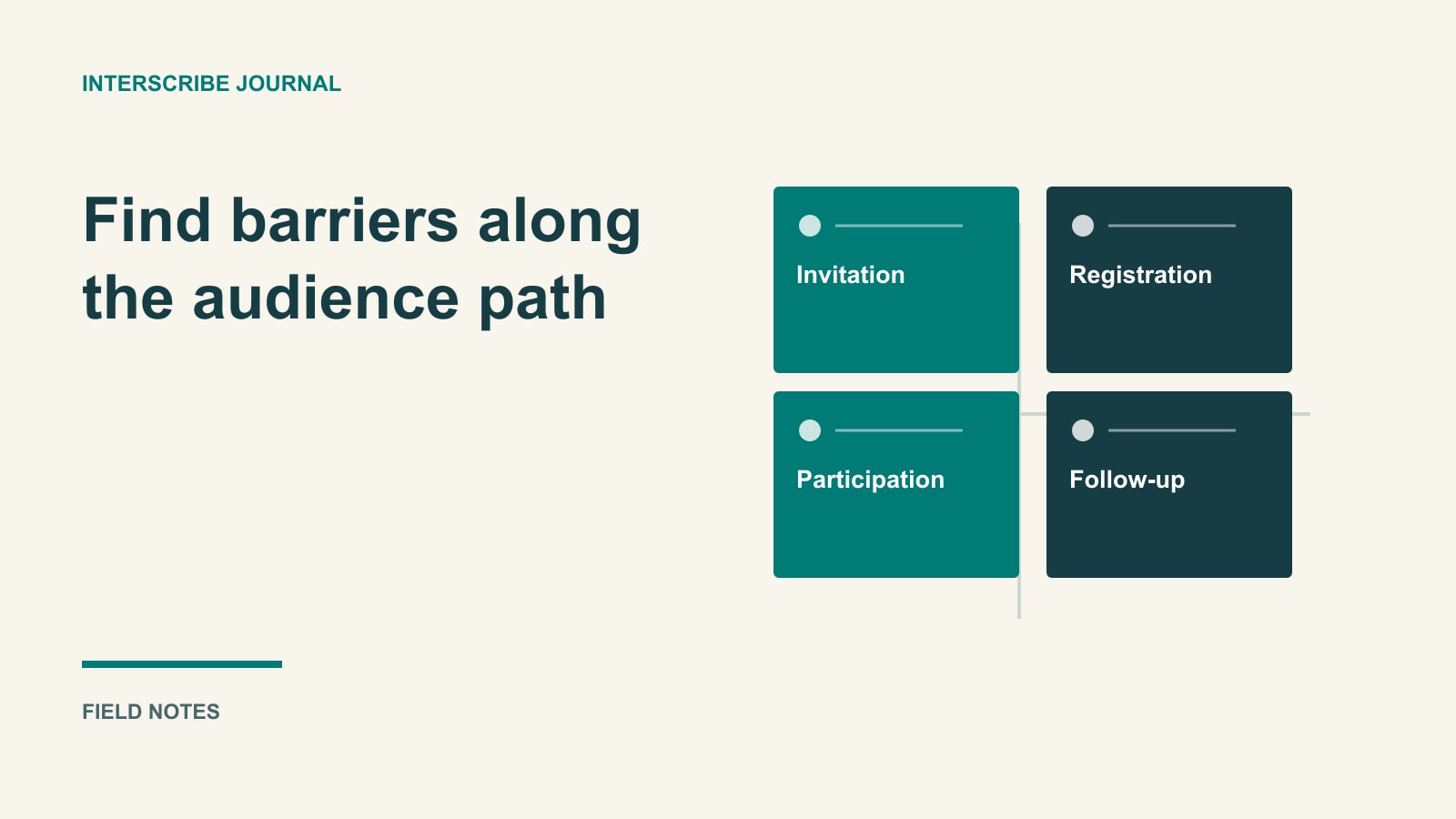
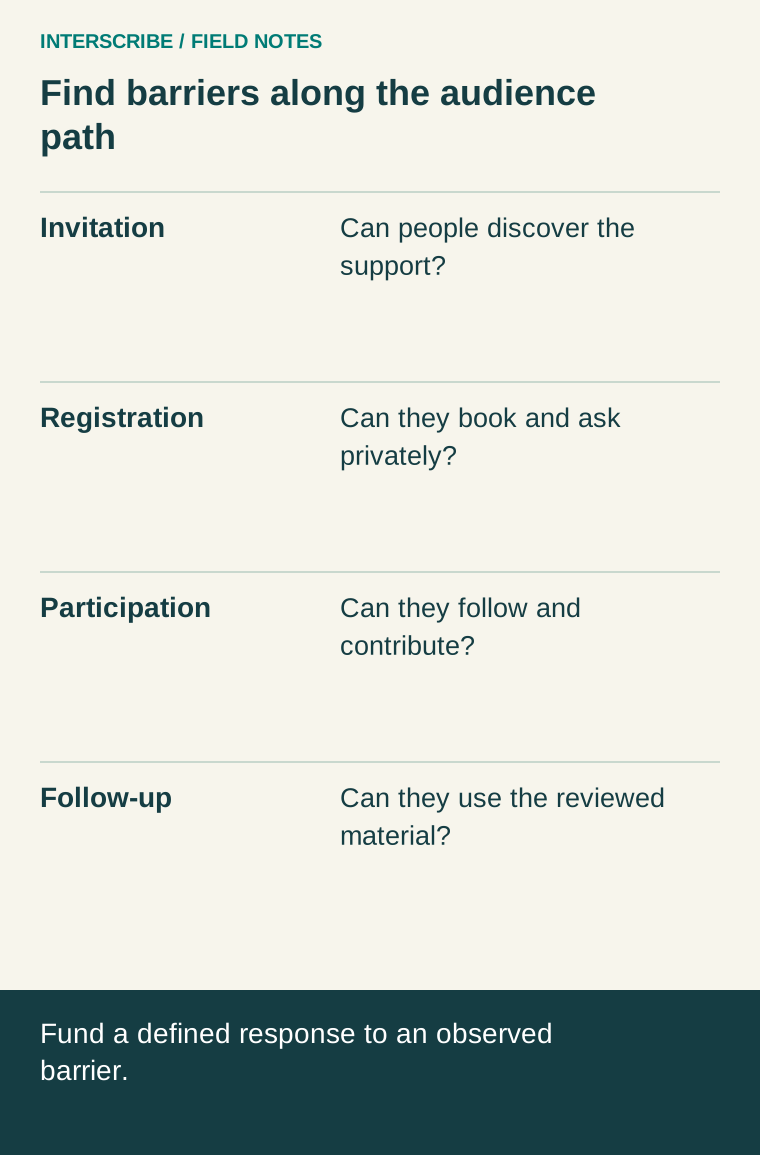
Write the participation goal in ordinary language. For example: “An attendee can find the session, follow the demonstration, ask a question, and obtain the reviewed instructions.” This reveals more work than simply buying a caption service.
Look for evidence outside the attendance count
Use several sources, keeping their limitations visible:
- Voluntary requests: identify stated needs, but absence of requests does not prove absence of barriers.
- Support conversations: reveal specific failures, but only from people who reached support.
- Task walkthroughs: show what a tester could or could not do in a recorded environment, not what every attendee will experience.
- Community conversations: can surface missing needs; one contact does not speak for an entire community.
- Registration and attendance: describe participation through the routes you measured, with separate definitions for registrations, people, and browser activity.
Invite people to describe what would help them participate. Avoid asking for diagnoses or making people justify ordinary reading or language preferences. Agree how feedback will be used and whether a person wants follow-up. Budget for participant expertise when commissioning a structured evaluation.
Compare the published invitation with the actual service. Does “multilingual access” specify which formats and sessions are covered? Does the help route work before someone purchases a ticket? A promise that cannot be checked is a poor starting point for either access or marketing.
A fictional conference discovery exercise
A fictional professional association is planning a workshop with a live software demonstration. Its team initially proposes adding several languages because international attendance seems like an attractive opportunity.
A small discovery exercise changes the brief. One prospective attendee wants to read captions while watching the demonstration. Another asks for spoken interpretation. A third cannot determine whether questions from remote attendees will reach the presenter. These are individual requests, not a population survey.
The organizer maps the barriers. Adding translated text alone would not resolve the requested audio arrangement or the question route. The team asks its access lead to confirm appropriate support, asks AV to test the actual demonstration, and assigns the moderator a remote-question procedure.
For the pilot, testers use the invitation, join from their own devices, follow a new demonstration step, and submit a question. The team records failures and corrections. It does not announce that these changes increased revenue or represent the preferences of all international attendees.
The investment decision becomes concrete: fund the agreed support, repair the joining instructions, and test the question handoff. Further language expansion remains an evidence-gathering question.
Build a one-page investment worksheet
Use one row per barrier. Several barriers may share a solution, but preserve the original tasks so you can verify each one.
| Audience and task | Evidence and its limits | Proposed response | Cost to obtain | Verification and owner |
|---|---|---|---|---|
| Prospective attendee finds support before booking | Direct request; one person's experience | Add a clear contact and coverage description | Communications time | Contact receives a test request; registration lead |
| Remote attendee follows a demonstration | Rehearsal on specified device | Arrange chosen text/audio support and test layout | Service, AV, rehearsal | Tester follows a fresh example; access lead |
| Attendee contributes a question | Moderator walkthrough finds missing handoff | Assign question monitoring and speaking procedure | Staff time | New question reaches presenter and audience; moderator |
| Participant retrieves instructions | Follow-up link not yet tested | Review and share the agreed document | Review and publishing time | Intended recipient opens correct version; content owner |
Add the decision date, unresolved limitations, and the person authorized to approve the response. Obtain actual quotes for professional services and current account costs. Include preparation, support, review, and accessible distribution; the software line alone is not the delivery budget.
Make the pilot answer a decision
Before the pilot, state what would change your plan. “We will learn about engagement” is vague. “We will decide whether this joining route and audio arrangement can support the workshop, or whether we need a different delivery approach” is useful.
Test the promised experience using the documented attendee joining routes. In InterScribe, reading and listening choices are distinct; use the language and voice guide to describe the options actually offered in your account. A supported option still needs an event-specific rehearsal.
Record the environment, task, observation, correction, and retest. Preserve unresolved barriers rather than averaging them into a satisfaction score. A single blocked essential task can require action even when other feedback is positive.
Report what changed without claiming more
A defensible report might say: “We identified three joining barriers, corrected two, and assigned the remaining issue before registration opens.” It should not say: “Captions unlocked a new global market” unless separate evidence supports that conclusion.
If you later examine attendance or revenue, document the comparison period, other campaign changes, and uncertainty. Use the accessibility investment worksheet for that financial analysis. For voluntary feedback, ask which task the attendee tried, what prevented completion, and what would help; report the number of respondents rather than treating their answers as the whole audience.
The immediate customer value is a clearer invitation, a usable participation route, and an accountable response when something fails. Those are concrete improvements worth planning and verifying on their own terms.