
A company offers translated captions for its quarterly town hall. The next week, a regional team receives a policy change through a slide deck, and a shift supervisor explains a new procedure verbally. Neither communication follows the town-hall plan.
An organization-wide language strategy starts with an inventory of work, not one default event setting. People need to receive updates, discuss problems, follow instructions, and raise private questions. The support and verification should match those tasks and the consequences of misunderstanding.
This guide is for internal communications and the teams that own the content. It does not promise improved retention, productivity, or compliance from adding a language service. It provides a way to assign decisions and discover whether the intended next step is clear.
Inventory communication before selecting a platform
Ask regional leads which recurring communications require people to act. Include shift briefings, onboarding, technical changes, employee forums, individual meetings, and written follow-up. Record who misses a live session because of schedule or access conditions.
Gather language and format preferences voluntarily and through appropriate workplace processes. Country, office location, surname, or browser language is not a reliable substitute for asking what someone needs for a task. Do not turn a language preference into a judgment about job competence.
Distinguish receiving from contributing. A person may follow a presentation but need another route to explain a problem, challenge an instruction, or ask about a personal situation. A broadcast translation plan is incomplete if it omits those return paths.
Use a purpose-and-consequence matrix
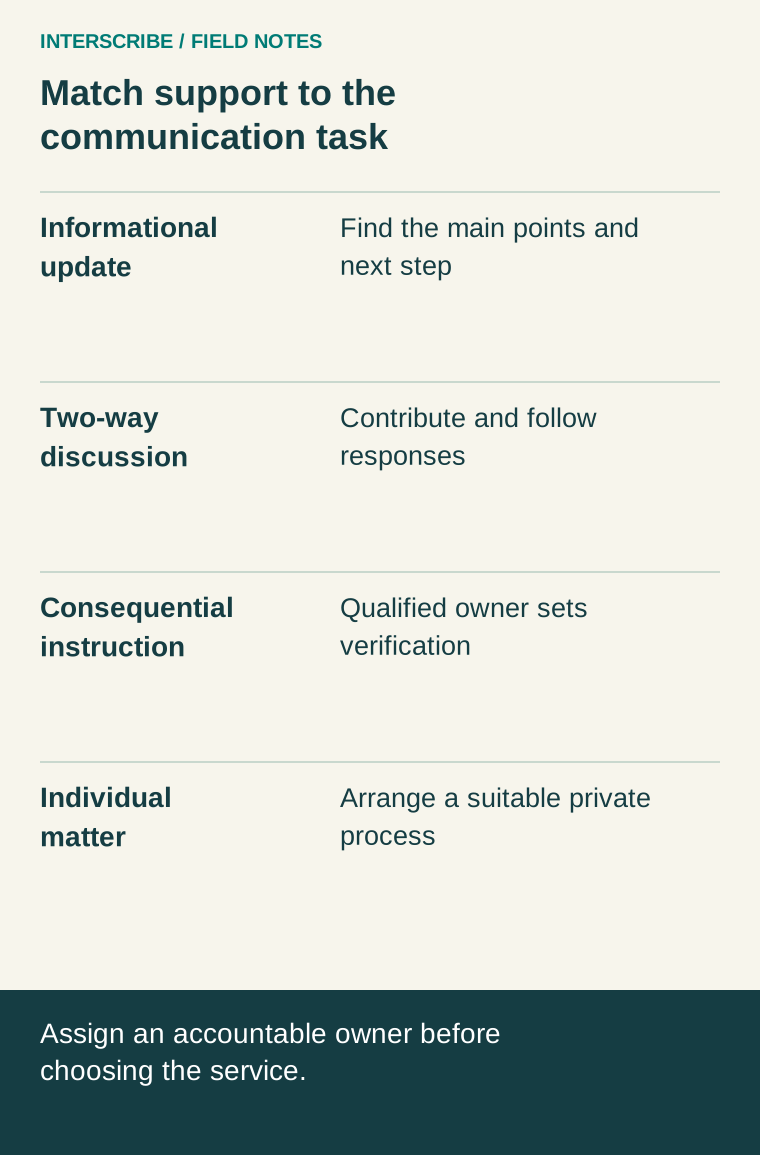
| Communication | Required participant task | Support decision | Review and authority |
|---|---|---|---|
| Informational update | Follow the main points and find further information | Reading/listening choices and a clarification route | Communications owner reviews wording and links |
| Two-way discussion | Express a view and follow replies | Appropriate language service and moderated turn-taking | Meeting owner and language provider rehearse exchange |
| Consequential instruction | Understand and apply an approved process | Qualified owner determines delivery and verification | Safety, legal, HR, or other relevant specialist |
| Individual matter | Discuss private circumstances and receive a response | Suitable confidential arrangement through the proper process | Authorized case owner |
The matrix does not rank people's needs by importance or assign every row to AI or humans. It identifies who must decide the arrangement and what evidence they need. A small private meeting can need more careful preparation than a large informational broadcast.
For U.S. OSHA-required employee training, OSHA's policy statement addresses presentation in language and vocabulary employees can understand and points to requirements in applicable standards. It does not establish that automatic captions satisfy a particular training duty. The workplace's responsible safety professional should assess the relevant standard and method. OSHA: Training Standards Policy Statement.
A fictional regional rollout
A fictional company is introducing a new internal service-request system. The central team plans a launch talk, while regional teams will help employees practice submitting requests.
The inventory reveals three different tasks. Everyone needs the general announcement. Service coordinators need to explain unusual cases in a discussion. Employees need to find the correct request category in a practice exercise. The team does not assume one translated recording covers all three.
Communications prepares a reviewed overview and offers the confirmed reading/listening arrangements. Regional leads arrange supported discussion with the relevant subject owner. The training lead creates a harmless practice case using invented details so employees can try the new process without submitting real personal information.
During the practice, several participants ask whether one label refers to technical support or facilities. The owner finds the English source label ambiguous. Rather than asking translators to guess, the content team clarifies the approved source, updates the affected language versions, and repeats the practice with a new case.
The fictional result is a documented correction and a revised delivery plan. It is not a claim of faster adoption or a measurement of employee ability. The process tests whether the communication and workflow support the intended action.
Keep the source and language versions connected
Assign an authoritative content owner before translation. Give each material a version, effective date where relevant, language, reviewer, and distribution location. If a term is ambiguous in the source, resolve it there rather than allowing different regions to invent conflicting meanings.
Maintain a small terminology record with the source term, intended meaning, approved local expression, context, and owner. Allow regional reviewers to raise a term that does not fit local usage. Central consistency should not prevent a necessary local clarification.
When the source changes, identify the affected language versions and scheduled sessions. Do not let an old transcript become the easiest-to-find instruction. Keep a correction route that reaches the people who received the earlier material, according to your organization's process.
Plan the live route and the follow-up separately
Where InterScribe is part of the approved arrangement, use glossary and context settings for preparation and language and voice choices to explain the actual attendee options. Verify account availability and the session configuration; text, AI voice, device read-aloud, and human interpretation are distinct experiences.
For a company-wide broadcast with in-room and remote participants, use the hybrid-event participation scorecard. This inventory should tell that event team what it must deliver, rather than duplicating their production checklist.
Afterward, the transcript workflow offers language-specific organizer exports. Assign review and intended distribution before sharing them. A raw transcript is not an approved policy, and it cannot retroactively provide a missed opportunity to ask a consequential question.
Copy this communication inventory card
For each recurring communication, complete:
- Purpose and task: What should the employee be able to receive, contribute, or do?
- Audience and conditions: Relevant shifts, remote access, devices, and confirmed language/format needs.
- Consequence: What could happen if meaning is missing or wrong?
- Decision owner: Who approves content, the communication arrangement, and verification?
- Delivery: Live and asynchronous routes, interaction, and private questions.
- Evidence: Reviewed sample, rehearsal, practice task where appropriate, and observed barriers.
- Correction path: How questions reach the source owner and updated material reaches recipients.
- Review trigger: Content change, new audience, incident, or scheduled renewal.
Use one card per distinct task rather than labeling every communication “high” or “low” risk and applying a fixed technology tier. The card should make an unowned decision obvious.
Close the loop without turning analytics into assessment
Ask participants what remains unclear and provide a route that does not require a public admission of difficulty. For a practical task, the responsible training owner can use an appropriate exercise to check the material and delivery. Keep that purpose clear and respect workplace privacy and assessment rules.
InterScribe's analytics documentation describes browser and connection activity. Those figures do not demonstrate that an employee understood a policy or can perform a procedure. Keep usage, voluntary feedback, and any formal assessment as separate evidence sources.
Review the inventory with regional and content owners. Resolve repeated ambiguity at its source, retain confirmed communication arrangements, and update the event briefs. A useful organization-wide plan makes the right person accountable for each communication task and gives employees a dependable way to obtain clarification.