
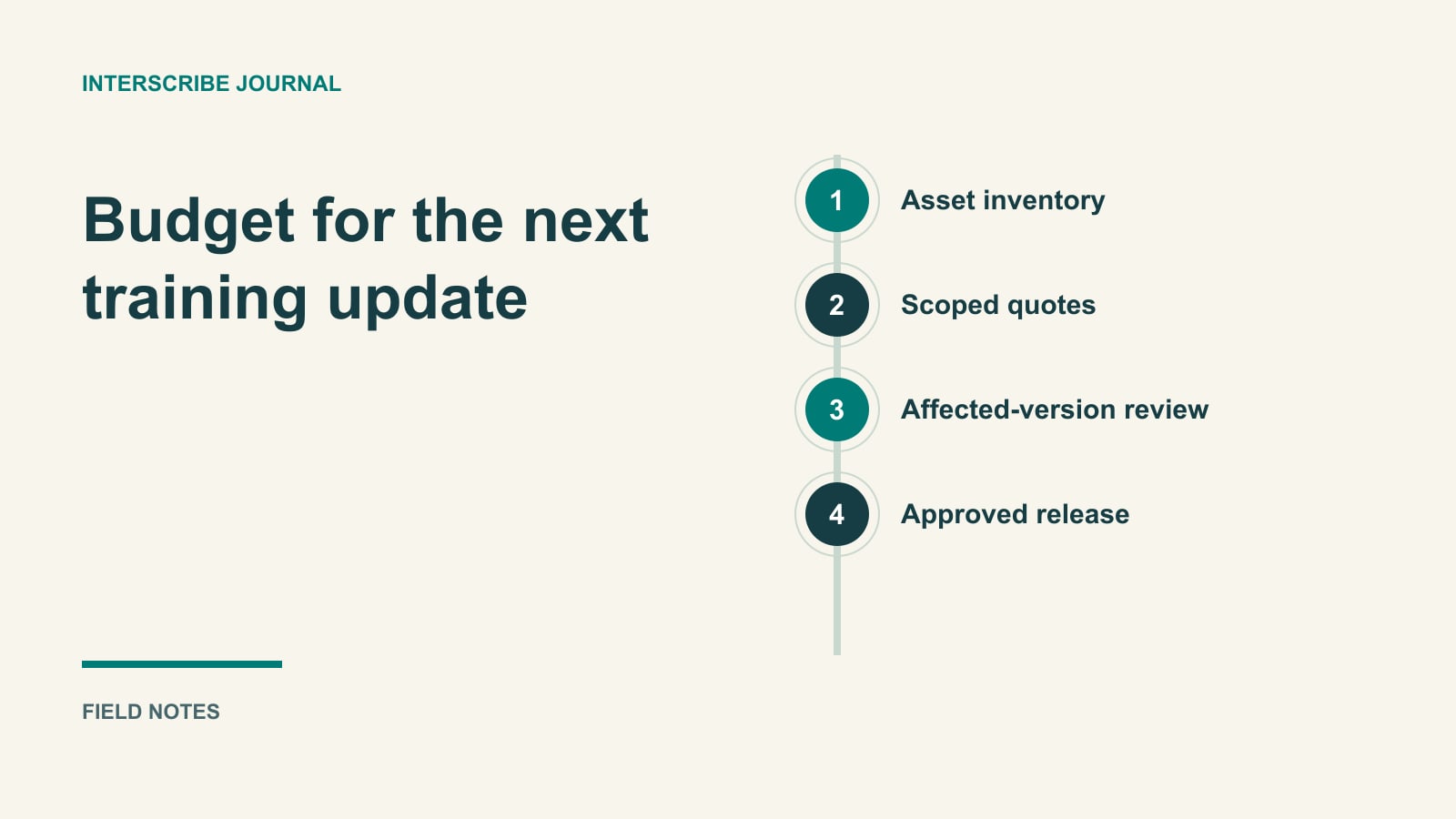
The first translation quote fits the budget. Then the policy owner changes a threshold, the assessment still uses the old rule, and the recorded demonstration shows an outdated screen. The team pays for another round without a clear view of what changed or which versions are safe to use.
A useful compliance-training translation budget includes the next update. It separates the source policy, the presentation, live discussion, assessment, and approved follow-up material instead of treating “translate the module” as one uniform job.
The calculations below are fictional planning examples. They are not market rates, InterScribe prices, vendor quotes, or promised savings. Use them to structure actual scope and estimates, not to negotiate from an invented benchmark.
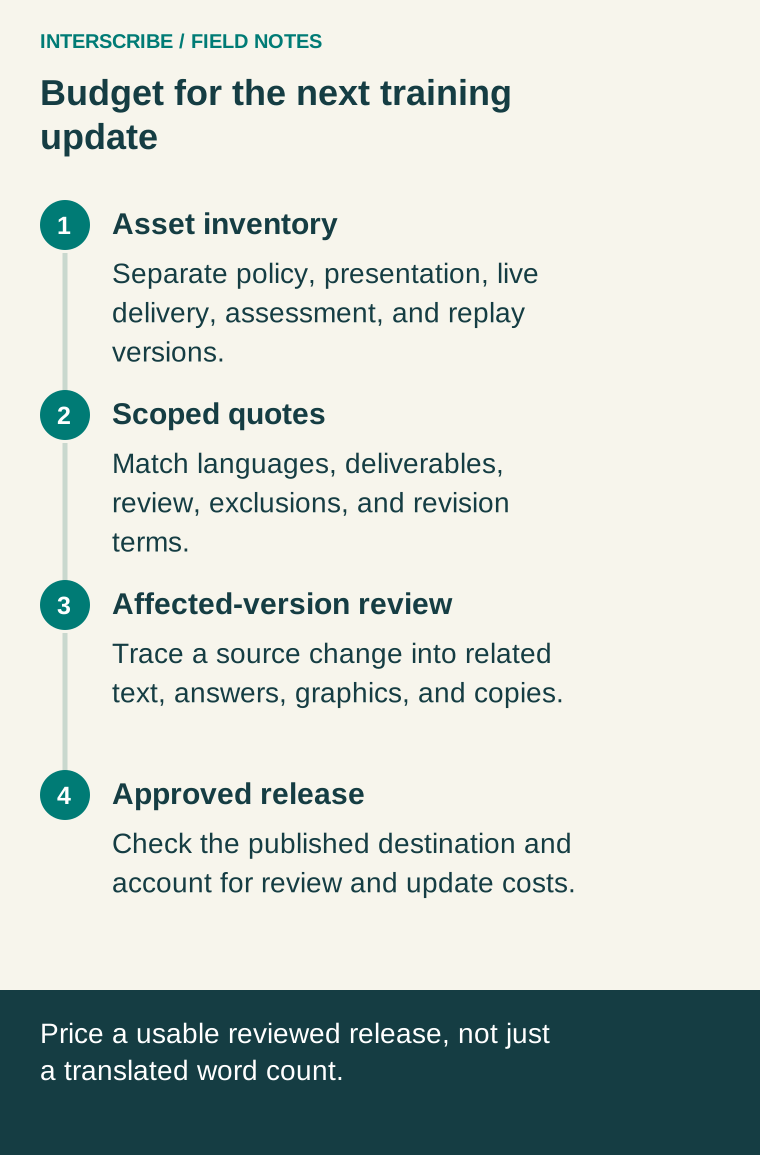
Inventory the assets before comparing prices
A slide deck and a policy document can repeat language while serving different purposes. A quiz may contain very few words but require careful review because a small change affects which answer is correct. Live questions introduce content that was not in the prepared script.
Build an inventory with one row per asset and version:
| Asset | Purpose | Scope to price | Review owner |
|---|---|---|---|
| Approved policy | Authoritative organizational instruction | Defined version and target languages | Authorized policy owner and language reviewer |
| Presentation | Explain the policy in the session | Slides, notes, examples, and graphics | Training lead |
| Live delivery | Present and answer questions | Languages, format, preparation, duration, and support | Event/language coordinator |
| Assessment | Check the intended learning task | Questions, options, feedback, and scoring meaning | Learning owner |
| Replay and reference | Support later use | Captions, text, layout, corrections, and publishing | Named content owner |
Record the source word count where relevant, but do not use it as the only description of the work. State whether the scope includes review, formatting, terminology preparation, corrections, project management, and a usable final file.
Choose the service by the task
Have the policy owner and appropriate language/access specialists determine what the audience needs and how consequential errors will be handled. Do not automatically classify all live training as suitable for AI-only delivery or every written asset as requiring the same process.
For employment access, the EEOC's employer guidance describes reasonable accommodation in relation to equal employment opportunity, including adjustments to training materials. A purchasing comparison does not decide an individual accommodation or legal requirement. Keep those decisions with the responsible people and budget for the agreed arrangement.
Automation may reduce some production work while leaving review, integration, and support work in place. Count both. If a generated output requires additional checking before release, that checking belongs in the estimate rather than appearing later as “unexpected overhead.”
Send suppliers the same scope
Ask each supplier to price the same language set, source version, delivery format, review rounds, and deadline. State who supplies the terminology and who approves disputed wording. Ask about minimum charges, rush work, revisions after approval, formatting, travel, taxes, and cancellation where applicable.
Separate quoted fees from internal labor and unresolved assumptions. A lower headline price can include less work; a higher price may include review that another quote excludes. Do not compare them until those differences are visible.
Use this quote-comparison record:
- Source/version: exact approved files and version identifier.
- Languages and audiences: confirmed needs, with any regional variation.
- Deliverables: file types, live services, accessibility checks, and publishing support.
- Included review: who reviews, how many rounds, and what triggers extra work.
- Update basis: changed-word, hourly, fixed-fee, or another agreed method.
- Dependencies: source freeze, reviewer availability, account features, and venue access.
- Exclusions: costs or tasks the buyer must supply separately.
A fictional initial budget
Imagine one module being prepared in two target languages. The buyer uses the following invented USD inputs only to test the arithmetic:
| Item | Fictional calculation | Amount |
|---|---|---|
| Written asset translation | 4,000 source words × 2 languages × $0.20 | $1,600 |
| Language/content review | 3 hours × 2 languages × $60 | $360 |
| Layout and assessment checks | 4 hours × $50 | $200 |
| Live-service allowance | Placeholder pending scoped quote | $800 |
| Coordination and rehearsal | 5 hours × $50 | $250 |
| Planning total | Sum of the five lines | $3,210 |
The allowance is not a confirmed live-service price. The example excludes taxes, travel, contingency, and any unlisted equipment. Replace each input with an actual quote or a named internal estimate before approval. The total is not a claim that this sum provides adequate staffing or access for a real event.
Price a change, not an entire imaginary replacement
Now suppose the policy owner revises a definition and its worked example. The change affects 300 source words, two assessment questions, and one slide graphic. The team does not assume the whole module needs retranslation, but also does not assume that only those 300 words need attention.
It checks related instructions, terminology, answers, captions, and existing copies. A supplier's revision terms determine the charge; minimum fees or broader context review may apply.
For this fictional exercise, assume no minimum fee and this agreed update scope:
| Update item | Invented calculation | Amount |
|---|---|---|
| Changed text in two languages | 300 words × 2 × $0.20 | $120 |
| Context and answer review | 1 hour × 2 languages × $60 | $120 |
| Layout and publication check | 2 hours × $50 | $100 |
| Change-order total | Sum | $340 |
Initial plan plus this one update equals $3,550. This is a worked estimate, not evidence of savings versus a full replacement. The example contains no recorded demonstration; if your module has one, assess and price its update separately.
Control the version that reaches employees
A correct revised document does not help if the LMS still points to the old one. Assign an owner to update the destination, retire superseded copies according to organizational policy, and verify the participant route.
Keep a change record with: source version, affected assets, languages, reviewer, approval, published location, and withdrawal/replacement action. Ask the reviewer to check references between assets, especially a quiz answer that depends on a changed policy condition.
For InterScribe-supported events, consult the actual account and hours and credits documentation when estimating relevant service usage. Confirm current commercial terms rather than inferring a billing formula from attendee count. Generated materials still require the review chosen for their intended use.
Report the cost of a usable release
After the rollout, compare the estimate with actual invoices and internal effort. Distinguish one-time preparation, recurring delivery, review, and change orders. Record why an overrun happened: late source changes, missing context, unclear scope, or a newly identified participation need.
Do not treat fewer language selections as automatic permission to remove support. Ask whether people knew about the offer and could use it, and consider confirmed individual arrangements separately.
Your final budgeting unit is a usable, reviewed training release—not merely a translated word count. A clear asset inventory and change process let you compare options honestly while preserving the work needed for people to understand and act on the training.