
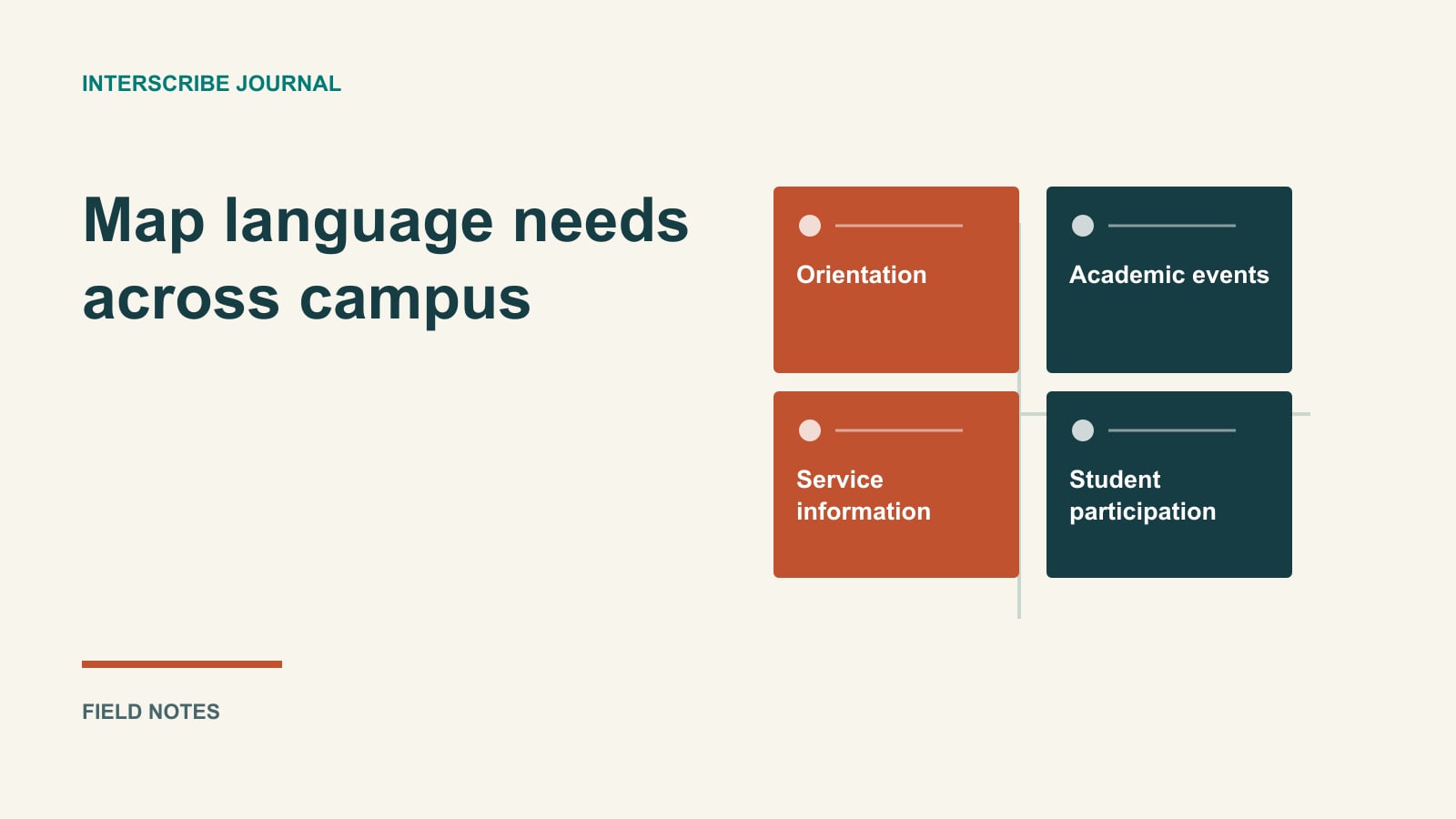
An orientation team receives a request for translated information and reaches for an international-enrollment chart. The chart may be useful for institutional planning, but it does not tell the team which language a student wants to read, whether they prefer audio, or how they will ask a question.
International students, multilingual students, and people learning English are overlapping descriptions, not interchangeable counts. A domestic student may want language support. An international student may prefer the event's original language. An individual's preference may change between a social introduction and a detailed administrative explanation.
This guide helps campus teams discover local participation needs. It makes no claim that a particular population is growing at your institution and does not promise retention or learning gains from adding translation.
Define the planning population precisely
Start with a specific service and period: incoming students attending this term's orientation, visitors joining an open day, or participants in a research seminar series. Record who is included and which people your evidence may miss.
If you need an enrollment trend, ask the responsible institutional data team for a consistent definition, time period, and source. Check whether a change reflects actual enrollment, a revised category, a different program mix, or a new collection method. Do not convert citizenship or country of origin into an assumed language preference.
For event planning, obtain information about tasks directly. Ask what people need to follow and contribute to the activity, then confirm the feasible arrangement through the relevant university process. Aggregate planning information where possible and keep individual support requests private.
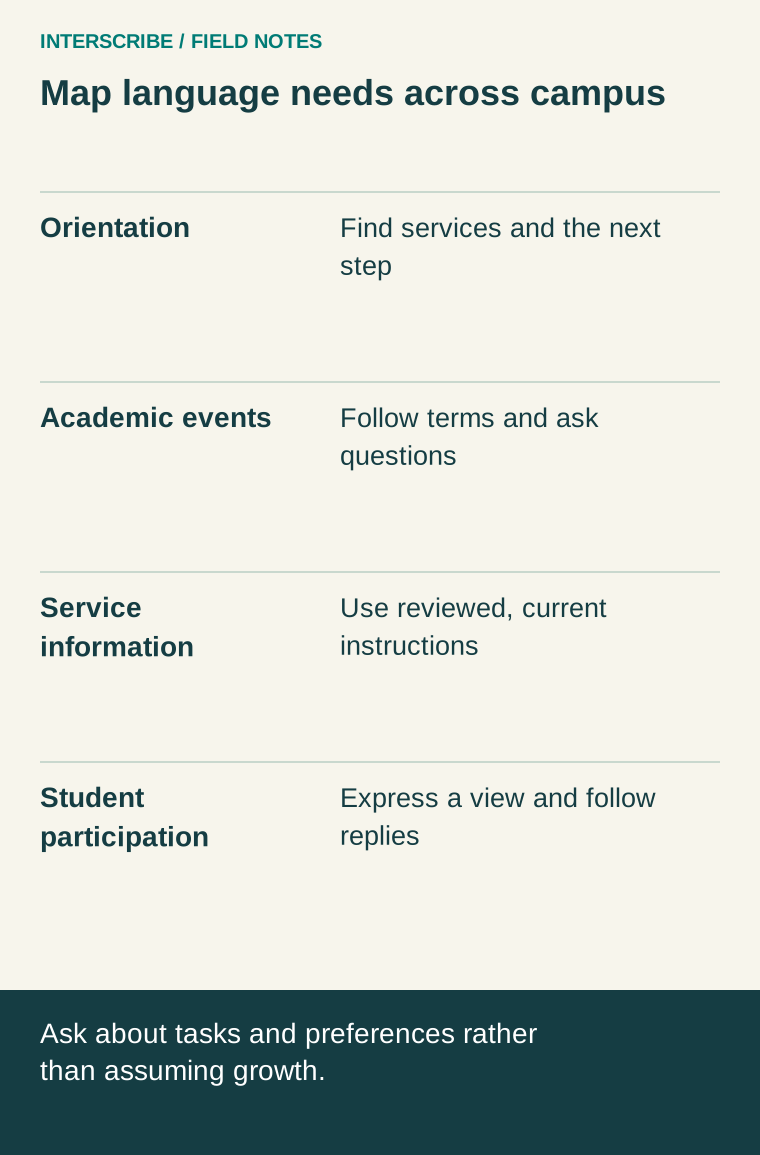
Map touchpoints beyond lectures
A language plan limited to the main lecture can miss the place where students need to act. Build an inventory with the owners who actually deliver the communication.
| Campus touchpoint | Participation task | Evidence to gather | Responsible partner |
|---|---|---|---|
| Orientation | Find a service and identify the next step | Voluntary preferences and a navigation trial | Orientation and student services |
| Research event | Follow specialist ideas and ask a question | Terminology sample and discussion rehearsal | Academic host |
| Administrative briefing | Understand the applicable process and obtain clarification | Reviewed instructions and questions from participants | Office responsible for that process |
| Student forum | Express a view and follow responses | Two-way language and moderation needs | Student organizers and support lead |
| Follow-up resources | Retrieve the correct current document | Recipient access and version check | Content owner |
For immigration, health, safety, financial, or other consequential matters, involve the qualified office responsible for the content. An automatically translated event transcript should not become the sole authoritative instruction merely because it is convenient to publish.
Use a short voluntary discovery survey
Make the survey accessible through the routes your audience uses and explain its purpose. Avoid requiring a proficiency label or asking students to disclose a diagnosis. Separate event planning from assessment of an individual's academic ability.
A useful short form asks:
- Which event or activity are you planning to join?
- Which language would you prefer for reading event information?
- Would you prefer to read, listen, use both, or discuss another arrangement?
- How would you like to ask questions or contribute?
- Is there anything about joining or following the event that we should plan for?
- May the event team contact you privately to discuss the arrangement?
Include a free-text route and “prefer not to answer.” Explain that a preference submission is not yet confirmation of a service; provide the confirmation process and contact. Do not collect nationality when the planning question is reading language.
A fictional orientation pilot
A fictional university plans an orientation segment about finding academic support. The team initially proposes choosing languages from an admissions nationality table. Instead, it sends a voluntary task-focused survey and speaks with student representatives and the relevant service office.
The responses identify different needs: some participants want original-language captions to check unfamiliar office names; others want translated text; one asks about spoken support. Several want the instructions available after the session. These responses describe the people who answered, not the entire incoming class.
The team prepares a short approved explanation and tests it with a harmless sample task: find the appropriate support page and identify how to contact the office. The first rehearsal shows that the translated text names the service but the follow-up link opens an outdated page. The content owner corrects the link and the team repeats the task.
The pilot report records the resolved navigation barrier, the confirmed support arrangements, and remaining questions. It does not claim that language technology caused higher retention or that a small convenience sample represents all students.
Connect the delivery choices to the evidence
Choose the event's source language deliberately, prepare specialist terms, and review translated material with someone competent in the relevant language and subject. The glossary and context guide describes InterScribe's preparation settings; those settings do not guarantee recognition or translation correctness.
Reading and listening are distinct choices in the documented listener workflow. Confirm the options actually available for the session and account. Explain them in the invitation without implying that every caption language has the same voice service.
Rehearse joining as a student. For a session requiring an access code, use the documented join page or portal with the event code and access code; do not distribute a direct link or QR code as though it provides the same access-code entry. See how audiences join.
Keep language planning connected to, but distinct from, disability accommodation decisions. The university accommodation journey addresses that institutional handoff.
Turn the pilot into a reusable decision sheet
For each proposed change, record:
- Audience and task: Who is trying to do what, during which activity?
- Evidence: Requests, survey wording and response scope, or observed trial.
- Arrangement: Reading, listening, contribution, and follow-up support confirmed.
- Content authority: Who approves consequential wording and updates?
- Test: New task sample, devices, language review, and observed barrier.
- Decision: Keep, revise, or obtain another service, with an owner and date.
- Limitation: Missing responses, untested situations, and unresolved requests.
Review this sheet when the event, content, or audience changes. Do not remove an arrangement solely because a report shows little activity; discoverability, availability, and browser counting affect what you see. Use the analytics guide for interpretation to keep those limits visible.
Your local planning evidence should tell the next organizer which participation tasks need support and how to deliver it. That is more useful than a generalized claim that the “ESL population” is growing everywhere.