
A guest lecturer is confirmed. The department has booked a room and sent the invitation. A student requests communication support, and the message is forwarded to three offices. Each office handles part of the work. Nobody tells the student what will happen next.
The problem is coordination. A useful university accessibility process connects the person making the request with the people arranging teaching materials, technology, support, and follow-up. It also gives the person a clear contact when the arrangement does not work.
This guide is an operational handoff for courses and academic events. It does not decide an individual accommodation, substitute for the institution's accessibility process, or establish legal compliance.
Name the decision authority and the coordination owner
Identify the institutional office responsible for accommodation decisions, and name an event coordinator who keeps the work moving. Those roles may be held by different people. Faculty, event staff, procurement, and IT need clear assignments, but they should not independently override an approved arrangement.
The Department of Education's guidance discusses auxiliary aids and services for qualified postsecondary students with disabilities under Section 504 and Title II. Use the institutional process to establish the support needed in the particular setting. Do not assume the same arrangement serves every student or every teaching activity. Department of Education: Auxiliary Aids and Services for Postsecondary Students.
Keep the legal framework separate from the run sheet. Public institutions should have their responsible authority assess the Title II web and mobile rule and current implementation dates. As checked on October 12, 2026, DOJ's fact sheet reflects an April 2026 extension of its compliance dates; do not copy an older deadline or select one using student enrollment. It also explains scoped exceptions rather than a blanket exemption for old content. DOJ: Web and Mobile Accessibility Rule Fact Sheet.
A private institution, federally funded program, or contracted service needs its own applicability analysis. Section 508 is not automatically the governing rule simply because federal funding exists. Use the education procurement evidence guide to document that assessment instead of repeating it in every event checklist.
Make requesting help straightforward
Put an accessible contact route in the invitation and course information. Explain what information helps the team arrange support, where a person can discuss needs privately, and who will respond. Avoid asking participants to post a diagnosis in a shared chat or volunteer registration spreadsheet.
Encourage early contact for planning, while keeping a route for later requests. A departmental planning date is not, by itself, a reason to reject a need. Route time-sensitive or disputed arrangements to the authorized office rather than leaving a host to make an improvised decision.
Confirm receipt and the next step. “We have forwarded your email” is not an arrangement. The coordinator should be able to say who is handling it, what still needs confirmation, and how the participant can follow up.
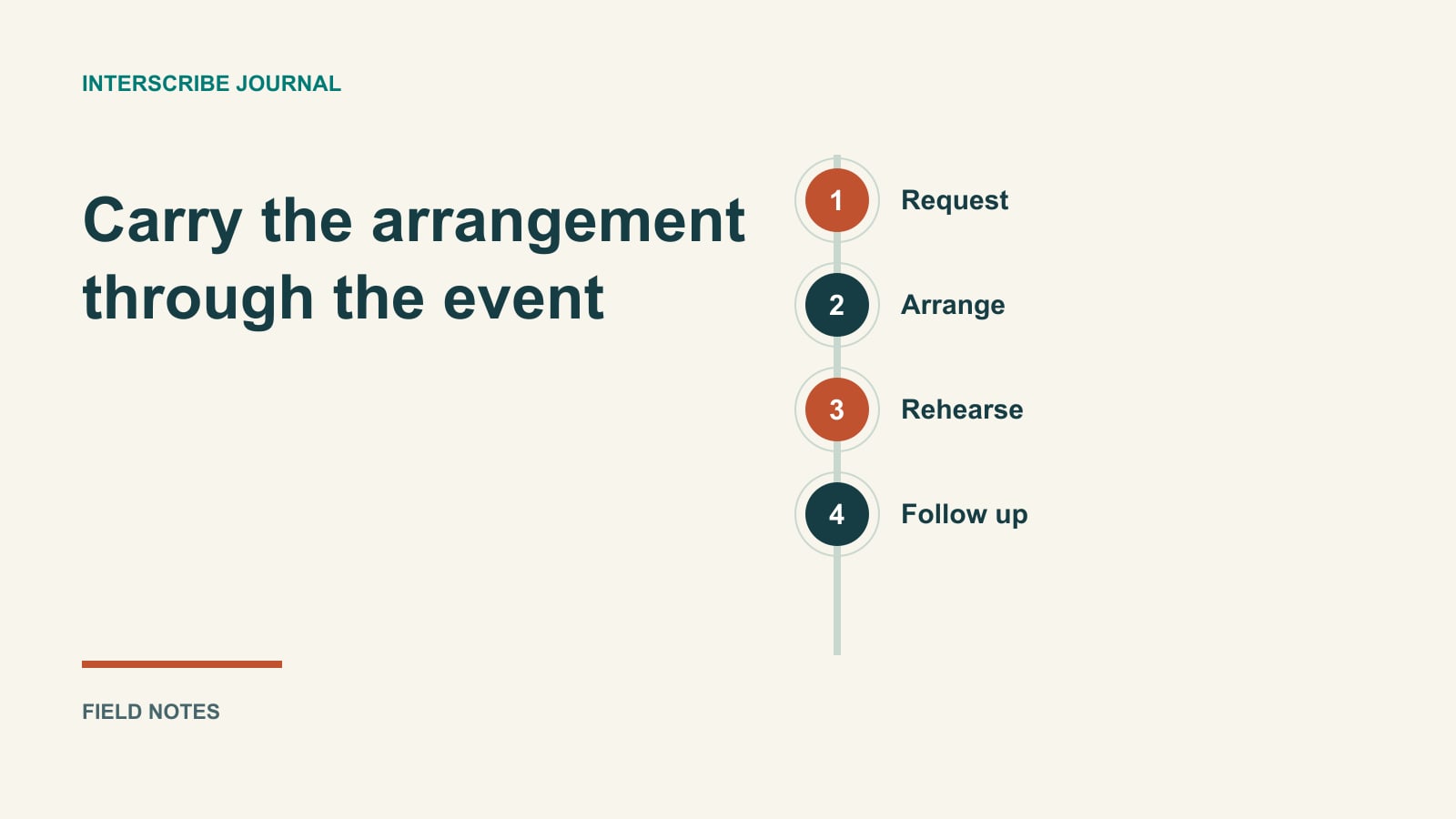
Give every stage an owner and a deliverable
| Stage | Responsible role | Deliverable and evidence | Escalation |
|---|---|---|---|
| Request | Accommodation office | Agreed arrangement through the approved process | Authorized institutional lead |
| Materials | Lecturer and content owner | Reviewed slides and other required formats | Department teaching lead |
| Technology | Event operator and accessibility tester | Tested attendee route and recorded barriers | Platform/service owner |
| Live delivery | Moderator and support provider | Working participation and clarification routes | Event decision-maker |
| Follow-up | Course/content owner | Reviewed, appropriately shared recording or document | Accessibility and academic leads |
Add a due date and named person to each row in your working copy. Keep private accommodation records in the approved system. The event run sheet needs the operational arrangement and contact route, not unnecessary personal information.
A fictional guest-lecture handoff
A fictional engineering department plans a hybrid guest lecture with a diagram demonstration and questions from the room. A student requests communication support through the university's usual process. The authorized office confirms the arrangement with the student; the coordinator then assigns the work needed to deliver it.
The lecturer supplies slides early enough for review and agrees to explain the meaningful changes in the diagram aloud. The operator tests the actual presentation and question microphones. The moderator practices repeating questions into the connected audio path, and the support provider receives the approved preparatory material.
During rehearsal, a remote tester can follow the lecture but cannot hear questions from the back of the room. The coordinator records a participation barrier. The team changes the question procedure, retests it from the attendee connection, and confirms who will interrupt if the problem returns.
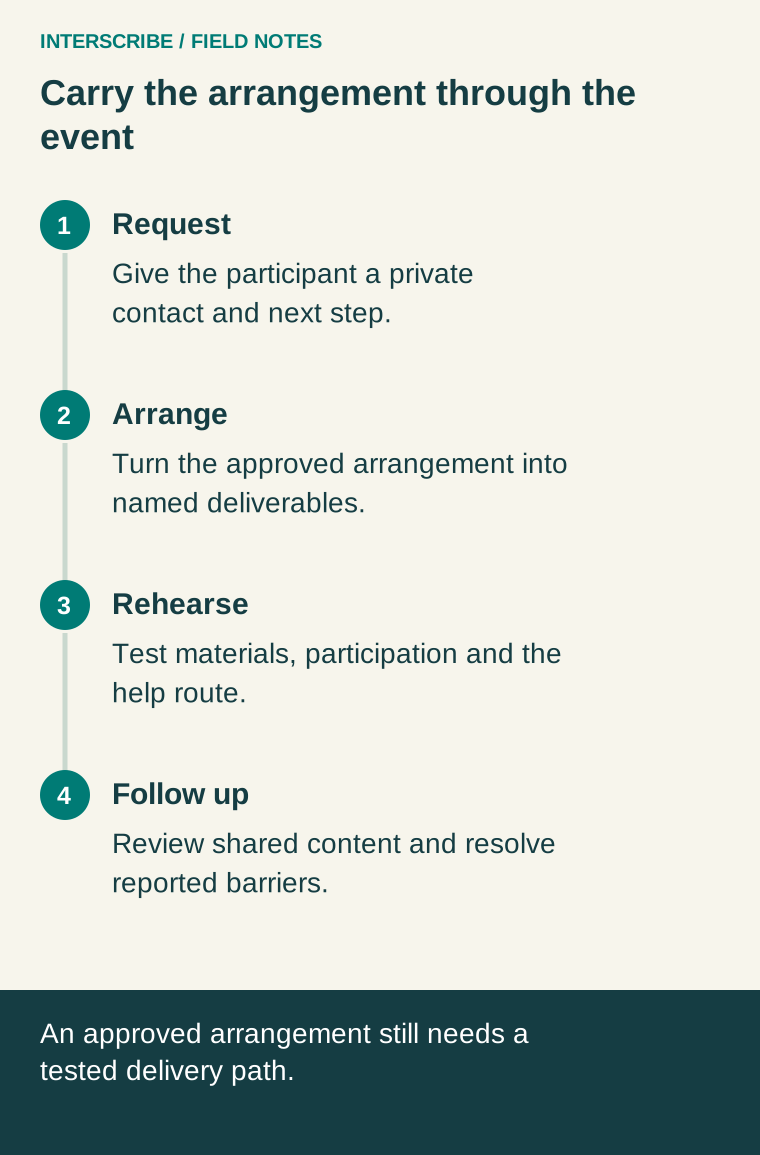
The lesson is the handoff: an approved arrangement becomes tested actions. This fictional sequence does not prescribe a particular service for every student or claim a successful customer outcome.
Rehearse with the attendee task in view
Walk through the actual invitation, sign-in, session selection, communication support, question route, and help contact. Include the person's relevant access methods with their agreement and the institution's process; do not make one participant responsible for certifying the whole platform.
Check the materials as well as the delivery system. A technically accessible player does not repair an unexplained visual demonstration. A reviewed slide deck does not repair a missing microphone. Give each observed barrier an owner who can change the source of the problem.
Where InterScribe is part of an approved arrangement, use the account's documented audio preparation and attendee workflow, then verify them in the environment you will use. A product feature list does not establish that the arrangement is adequate for a particular student. This guide makes no claim that your account or institution has completed those checks.
Record a barrier so someone can fix it
Use one short record per issue:
| Field | Fictional rehearsal entry |
|---|---|
| Task affected | Follow questions from the room |
| Observation | Remote tester heard the answer but not the question |
| Immediate arrangement | Moderator repeats each question into the connected microphone |
| Owner | Named moderator, backed by event operator |
| Retest evidence | Tester heard a new question and confirmed the exchange |
| If it fails live | Pause the answer and use the agreed supported question route |
| Follow-up | Review the recording for missing question context before release |
The entry should distinguish an interim arrangement from a permanent fix. Do not close an issue just because a ticket was sent to a vendor. Close it when the responsible team has evidence of the agreed outcome, or explicitly record the remaining limitation and decision.
Treat follow-up as another delivery stage
Before sharing a recording, caption file, transcript, or summary, assign review of meaning, relevant visual information, and recipient access. Confirm which material is part of the course or event and which version is approved. A transcript is not automatically a substitute for the original participation opportunity.
Do not label all archived recordings exempt or all old recordings subject to one identical rule. Have the institutional authority assess the actual content, use, and applicable requirements. A recording reused in current teaching needs an explicit decision; its age alone is not a complete analysis.
After the event, ask about concrete tasks: finding the session, following the presentation, contributing, and obtaining help. Carry unresolved barriers into the next course or event with an owner and review date. The outcome to seek is a reliable journey from a person's need to a delivered arrangement, with a usable route to correction when something fails.