
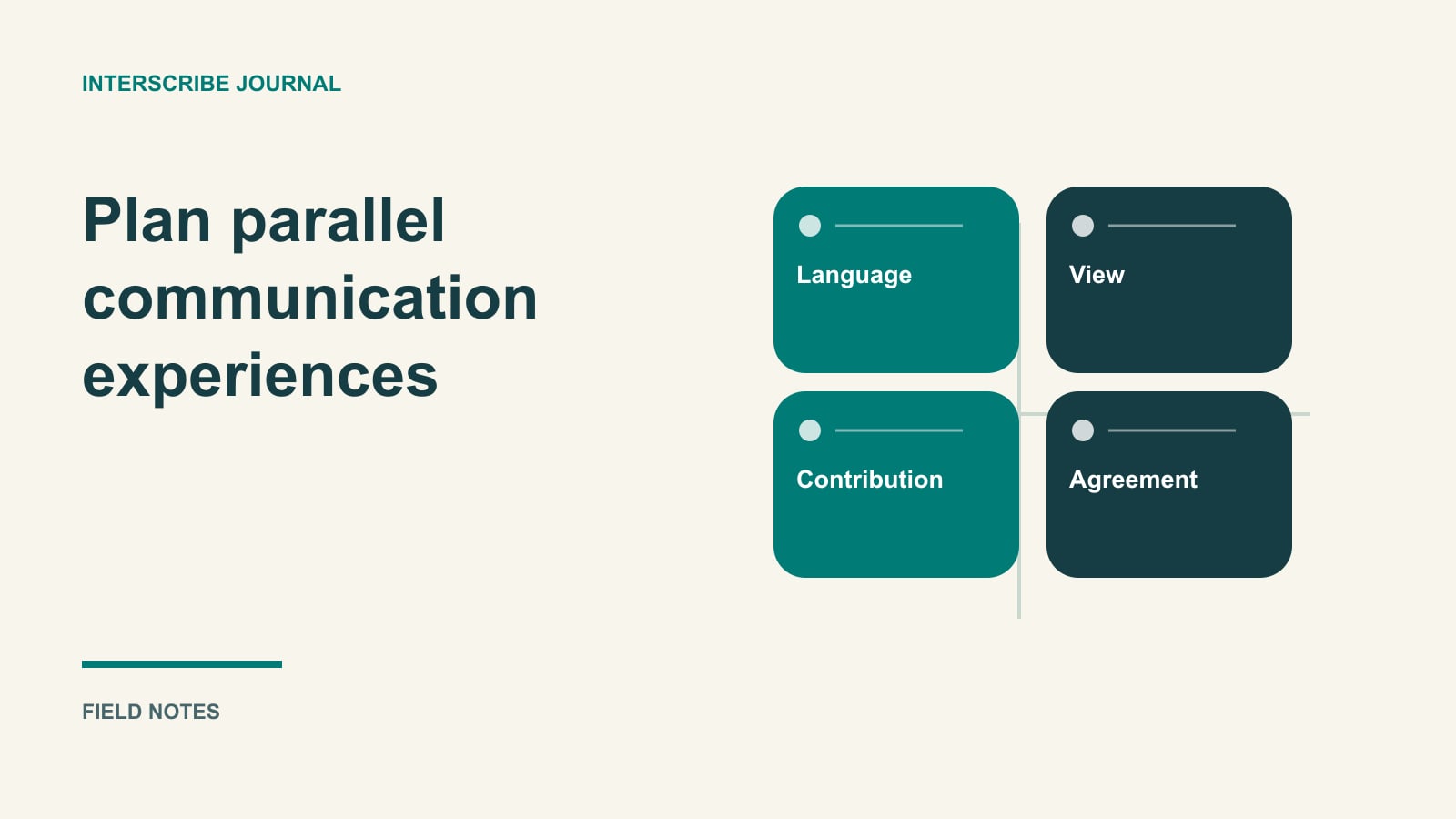
An organizer offers English captions after an attendee asks about ASL interpretation. The organizer sees two ways to present the same speech. The attendee may see two different languages and two very different ways to participate.
The useful question is what communication arrangement works for the person and the activity. Start that conversation before selecting a supplier or building the screen layout. Avoid using an attendee's hearing status, nationality, or preferred reading language to make the decision for them.
This guide compares the experiences and gives you a conversation and rehearsal tool. It does not determine an individual's accommodation or replace the responsible accessibility process.
Keep language and format distinct
American Sign Language is a language with grammar distinct from English. It is not written English expressed word by word with the hands. Sign languages also differ across countries and regions; ASL is not a universal sign language. NIDCD: American Sign Language.
A sign-language interpreter works between the languages needed for the assignment. Confirm the actual language combination and the required direction of communication with a qualified provider. Do not assume an ASL user must be an English speaker or that an international attendee cannot use ASL.
Captions provide written language. Live captions may be produced by a human captioner or an automated system; those are different service arrangements to evaluate. Translated text also needs review of meaning. Neither the presence of text nor the presence of an interpreter proves that the event's entire participation route works.
A person may request sign-language interpretation, captions, both, or another arrangement. People sharing a language or disability description can still have different needs. The conversation should make room for those differences.
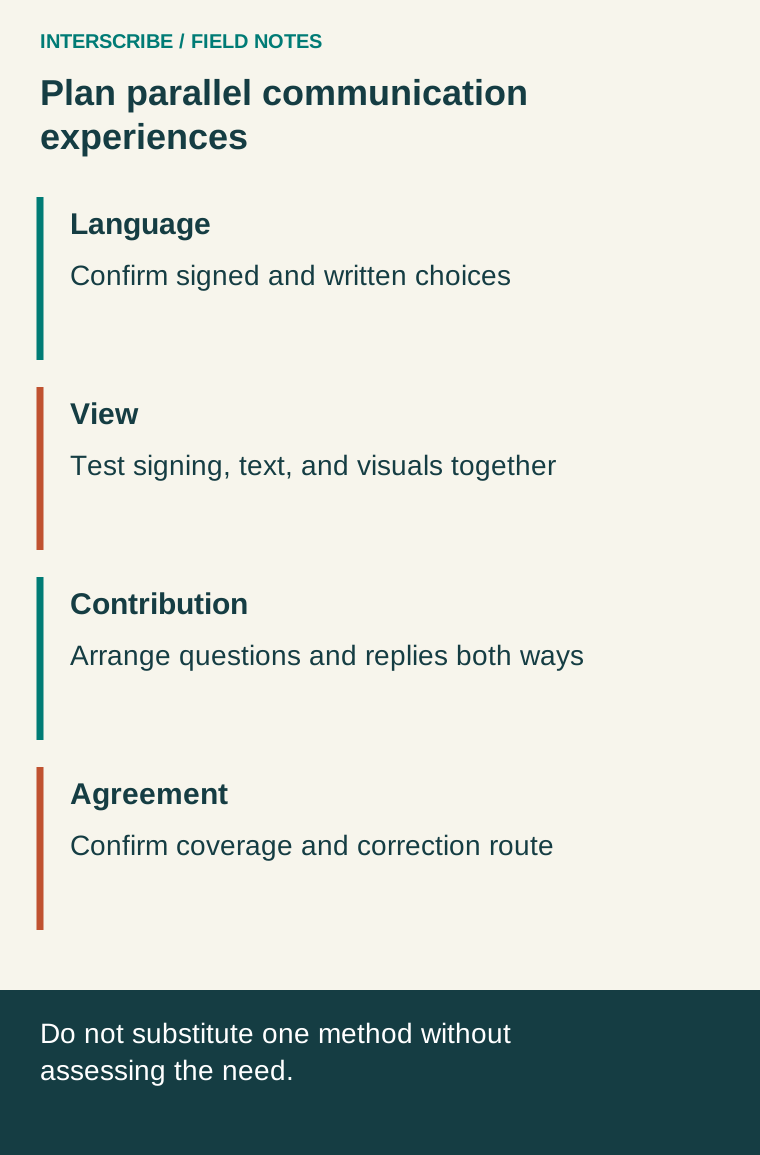
Compare what must be arranged
| Planning question | Sign-language interpretation | Live captions |
|---|---|---|
| Language | Confirm the sign language and other language directions | Confirm written language and any translation |
| Receiving the presentation | Interpreter has suitable source access; attendee sees signing clearly | Required speech and relevant audio information reach readable text |
| Contributing | Arrange how a signed contribution reaches other participants | Arrange the person's chosen question or discussion route |
| Visual attention | Test interpreter, speaker, slides, and demonstration together | Test captions, slides, and demonstration together |
| Service continuity | Agree team, breaks, handovers, and technical support | Agree coverage, monitoring, breaks where relevant, and response |
| Follow-up | Agree what later material is needed and permitted | Review captions or transcript before sharing |
These are parallel planning concerns, not a ranking. Captions can be unsuitable for a particular person's language needs; an interpreter video can be unusable if too small or missing during the discussion. A combined arrangement still needs a workable layout and pace.
Have a practical accommodation conversation
Use a private route and involve your accessibility lead. Ask about participation rather than unnecessary medical detail:
- “Which language and communication methods would let you follow this event and contribute?”
- “Which parts will you attend: presentation, discussion, workshops, or informal activities?”
- “Will you join in person or remotely, and are there viewing or device conditions we should plan around?”
- “How would you like questions and replies handled?”
- “May we confirm the proposed arrangement with you before the event, and what is the best contact route?”
Then provide a concrete response: covered sessions, format, contact, unresolved detail, and next update. Do not make the attendee responsible for finding a provider or certifying your technology.
For U.S. entities covered by ADA Title II or III, DOJ's guidance connects effective communication to the communication's context and the person's usual methods. The rules differ by entity and circumstances; have the responsible authority assess the request. DOJ: Effective Communication.
A fictional workshop arrangement
A fictional professional workshop includes a presentation and a small-group design discussion. One participant requests ASL interpretation; another requests written captions. The organizer confirms the arrangements through its access process rather than asking either participant to accept the other's format.
The initial rehearsal covers only the presentation. The interpreter is visible and the captions receive the presenter's microphone. During the discussion trial, however, the remote group cannot see a participant signing, and table comments do not reach the caption source.
The team revises the discussion procedure. The access lead and interpreting provider agree the camera and contribution route; AV tests the required sound sources; the moderator structures turns so contributions and responses can be followed. A further trial uses a new question and checks both receiving and contributing.
This fictional example is not a universal room design or a claim that one technology resolves the problem. It shows why the chosen communication methods must extend to the activity people came to join.
Test visibility without prescribing one universal layout
Invite the provider and participants, where appropriate and with their agreement, to examine the view from relevant seats or devices. Can the attendee see the interpreter's signing and facial expression? Can they follow the associated visual material without missing essential information? Does a screen-share change hide the interpreter?
For captions, examine size, contrast, timing, speaker changes, and the content actually conveyed. Include questions and meaningful non-speech audio where needed. A clear introductory sentence is not enough to test a panel or a video segment.
Discuss pacing with presenters. If everyone is expected to inspect a detailed image, leave time to do that before moving to the next point. Confirm breaks and handovers with the service providers based on the assignment; do not derive staffing from a generic attendance count.
Understand the platform boundary
Where enabled for an account, InterScribe documents a human sign-language video channel beside captions. The organizer arranges the interpreter. The camera booth sends video only, so source access and a two-way discussion arrangement need separate planning. Check availability and the sign-language guide before promising this workflow.
A video window is a delivery component, not proof of effective interpretation or a complete interactive service. If a needed feature is unavailable in the account, resolve the delivery arrangement before inviting attendees to rely on it.
Record the final plan in a compact handoff: participant-approved communication arrangement, covered activities, provider contact, viewing test, question route, break plan, and response to failure. Use whole-event Deaf access rehearsal to carry it through arrival, transitions, and follow-up. Keep the plan open to correction when the actual experience does not work.