
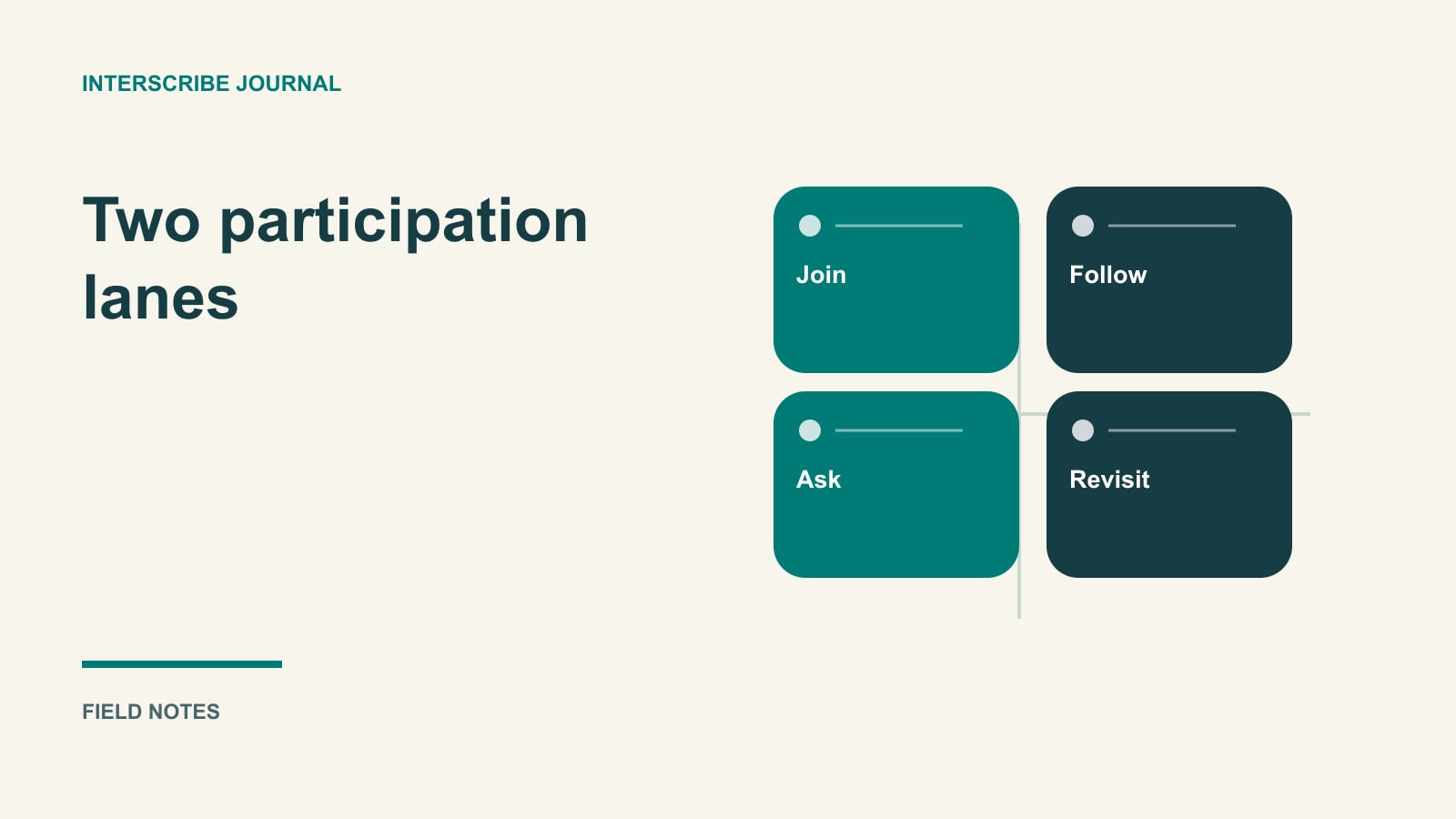
Replace a market headline with a participation test
A statistic about the popularity of hybrid events cannot tell you whether a remote attendee can hear a question from the back of your room. Your next investment decision needs evidence about the event you are actually planning.
This guide replaces broad industry forecasts with a two-lane scorecard: one lane for people in the room and one for people joining remotely. The aim is not identical experiences. It is a credible way for each group to complete the important tasks, with clear owners for the gaps.
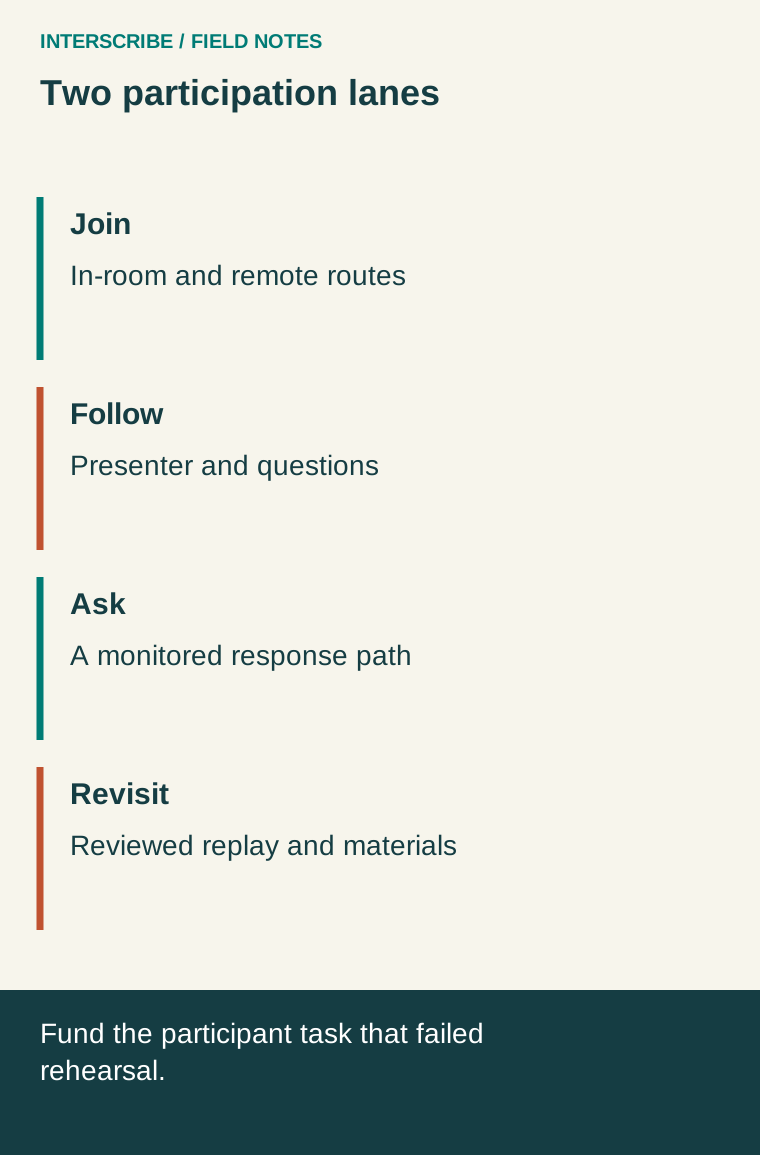
Define the jobs before counting attendance
Choose a small number of event tasks. For a training session these might be hearing an explanation, reading language support, asking a question and finding the approved procedure afterward. A networking reception needs a different scorecard.
Write down what completion looks like. “Remote engagement” is too vague to test. “A remote participant can submit a question and hear the answer, including the question repeated by the host” produces an observable rehearsal.
Keep three kinds of evidence separate: platform records describe recorded activity, observations show what happened in a test, and participant feedback describes respondents' experiences. None is a complete substitute for the others.
A fictional hybrid workshop
Imagine a professional association preparing a two-hour workshop for 40 people in a room and 30 registered remote participants. These are fictional planning numbers. The organizer has budget for either a second camera or a staffed question queue, but not both in this pilot.
During rehearsal, a remote volunteer sees the slides clearly and can hear the presenter. When a person in the room asks a question without a microphone, the volunteer hears only the answer. A second remote volunteer submits a question in the meeting chat; nobody notices it.
The team chooses a microphone runner and a named question moderator before buying the second camera. This is not proof that moderation always produces a higher return. It is a decision grounded in the missing tasks revealed by this rehearsal.
| Task | In-room finding | Remote finding | Pilot change |
|---|---|---|---|
| Join | Entrance sign points to the right room | Invitation contains two unexplained links | Label the video link and language-support link |
| Follow | Presenter audible | Audience questions absent from feed | Use a question microphone and repeat the question |
| Ask | Raised hands noticed | Chat questions missed | Assign moderator and explain the queue |
| Revisit | Handout available | No agreed replay or materials location | Publish an approved follow-up route |
After the changes, the team repeats exactly those four tasks. It records unresolved defects rather than turning a single successful rehearsal into a promise about every device or network.
Build a scorecard with honest denominators
Registration belongs to the registration system. Video attendance belongs to the meeting or streaming system. Language-channel activity belongs to the language service. Survey answers belong to the survey. Decide which source supplies each measure before collecting it.
InterScribe's documented analytics view distinguishes people from connections: its people measure refers to distinct browsers opening a channel, while connections include connection events. Neither should automatically be treated as a count of unique event attendees. A person using two browsers can complicate the comparison with a registration list.
The same guide distinguishes published caption output from audience listening modes. Producing captions in a language is not proof that a participant used them successfully. Read the definition shown with the actual report and preserve it in your evidence sheet.
| Measure | Source and denominator to specify | Question it can help answer |
|---|---|---|
| Registration | Eligible invitations and completed registrations | Did the invitation reach the intended audience? |
| Arrival | Defined attendance record and registered cohort | Did registrants find their way into the event? |
| Task completion | Rehearsal participants assigned that task | Could people follow and contribute? |
| Follow-up access | Defined link events or direct feedback | Could people find the approved materials? |
Do not add these counts together. They describe different stages and may count the same person differently.
Treat live distribution and replay as separate plans
An event can have a usable live session and an unusable recording. Before promising a replay, identify the person responsible for permissions, editing, reviewed captions and the final publication location. Decide whether audience questions will remain, be edited or require additional permission.
A transcript is useful for searching and reference, but it is not synchronized replay captions. If participants need to follow a recording visually, test the recording with its caption track. If the content contains visual demonstrations, determine what additional explanation the intended audience needs.
Do not assume that a live-stream destination carries every language or accessibility option available elsewhere. Test each advertised destination from a participant account or device. Keep the participant's instructions short enough to use while joining.
Copy this investment worksheet
For each proposed purchase or staffing change, complete one row:
| Field | Example from the fictional pilot |
|---|---|
| Failed participant task | Remote attendee cannot hear audience questions |
| Evidence | Two rehearsal observations with the same missing room feed |
| Proposed change | Microphone runner plus host repeat-back |
| Owner and cost basis | Event producer; actual staffing quote still required |
| Repeat test | Remote observer summarizes the question before the answer |
| Decision date | Before invitations promise the final experience |
Also record who was absent from the rehearsal. A test with internal staff on office Wi-Fi does not represent all intended participants. Recruit a small variety of relevant setups and invite specific feedback without describing that sample as representative research.
Decide what to fund next
At the end of the pilot, keep a short decision log: task, evidence, change, result and remaining limitation. An unresolved essential participation barrier needs an arrangement or a revised promise, not a favorable average score.
A useful hybrid-event plan makes the next action obvious. It may justify equipment, staffing, clearer invitations or a smaller initial scope. The value of the scorecard is that it shows which participant problem the investment is meant to solve, instead of borrowing confidence from unrelated industry statistics.