
A colleague speaks the visitor’s language, so someone asks them to “translate for a few minutes.” The welcome is easy. Then the conversation becomes a detailed complaint, a confidential disclosure or a presentation full of unfamiliar terms. The colleague is still bilingual; the assignment has changed.
Good language support begins by naming the job. It also gives the person a real opportunity to decline it. Availability is not evidence that someone can interpret this subject, in this direction, under these conditions.
Separate welcoming from interpreting
Welcoming someone, explaining where a room is and reading an already approved notice are different from conveying a speaker’s meaning live. A bilingual employee may be well suited to the first tasks and need training, preparation or a professional colleague for the others.
Ask about the particular language pair and direction. Someone may discuss their work comfortably in two languages but find it difficult to listen, retain meaning and reformulate unfamiliar speech while another person continues talking. Consecutive delivery provides pauses; it does not remove the need for interpreting competence.
For consequential or sensitive conversations, involve the person responsible for that service and a qualified interpreter when appropriate. Establish applicable professional requirements with that owner. A blog cannot decide the staffing rules for a particular clinical, legal or safeguarding situation.
The AIIC professional ethics guidance treats competence and appropriate working conditions as professional responsibilities. Use that principle to discuss the assignment, rather than treating bilingualism as an unrestricted job description.
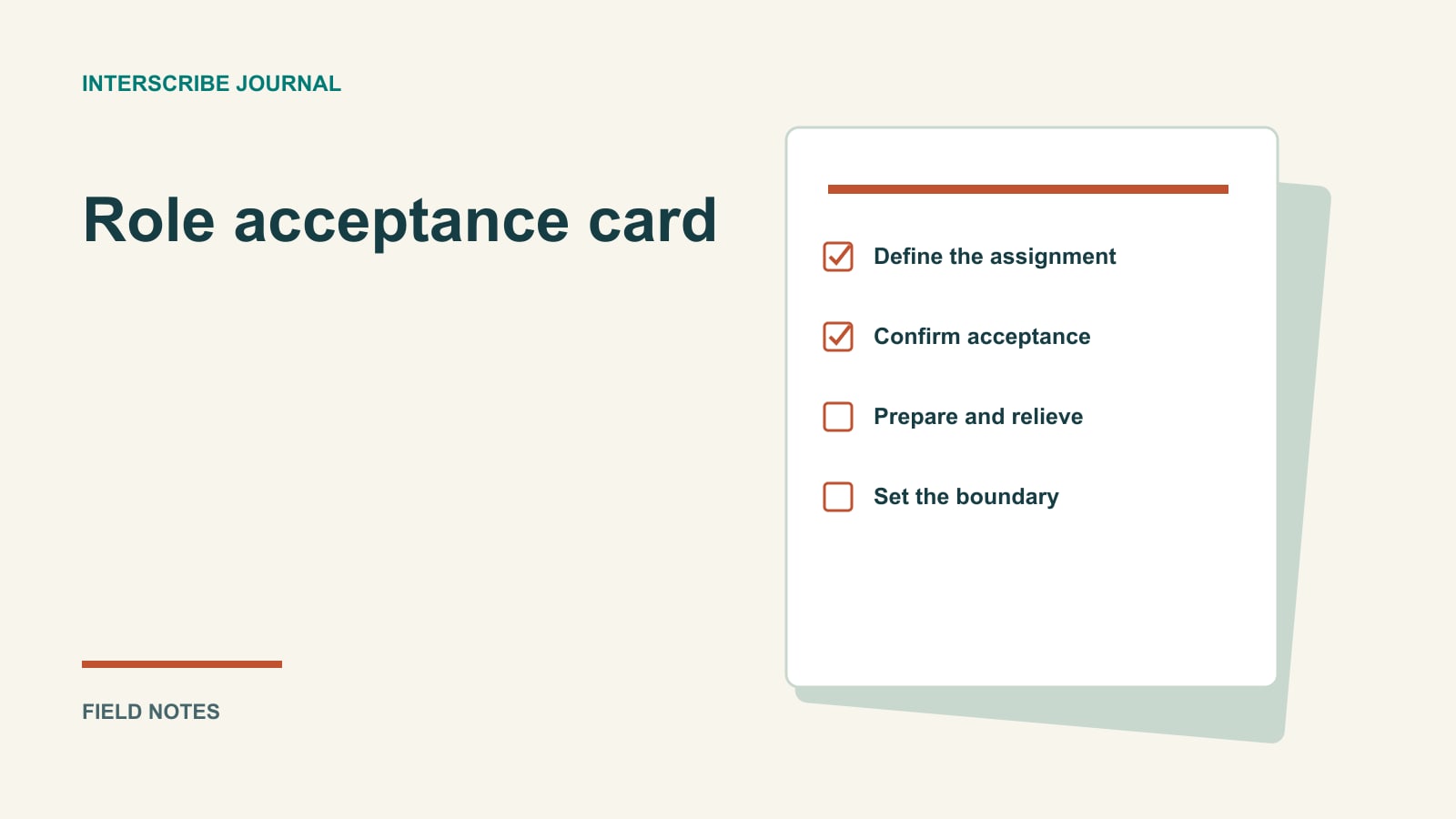
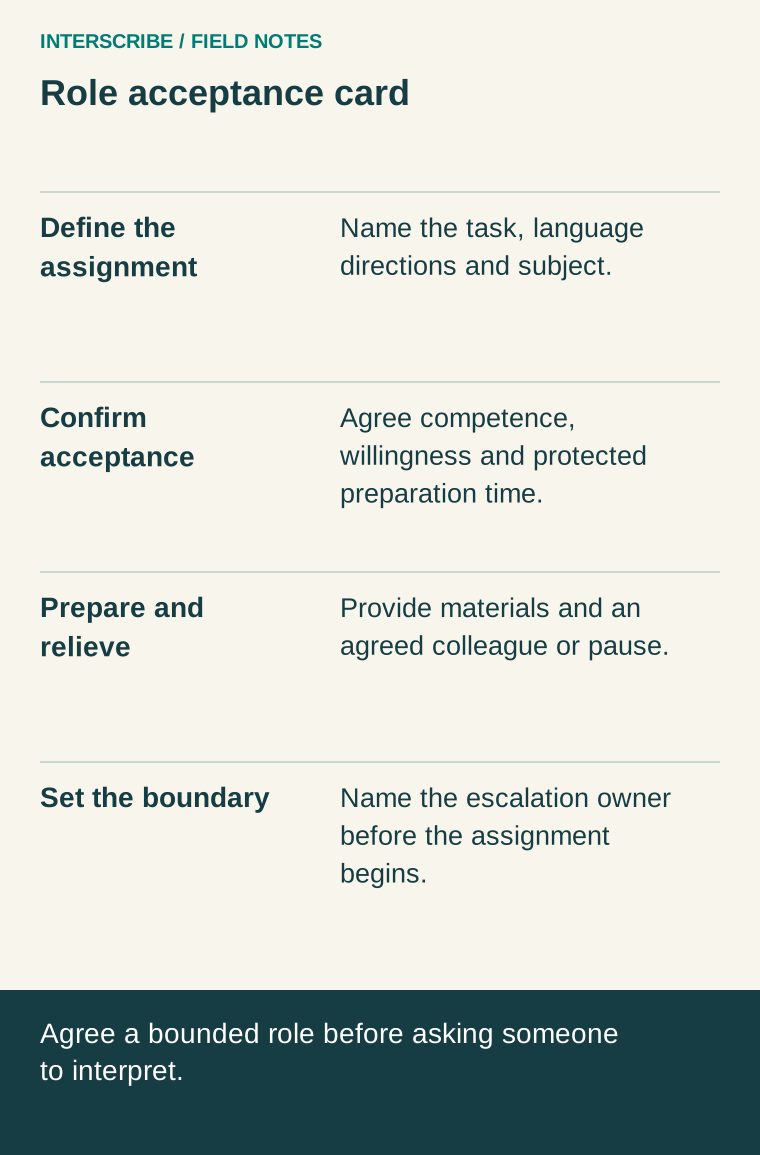
Use a role acceptance card before booking
Copy this card into the event brief. Complete it with the staff member, not for them.
| Question | Record before accepting |
|---|---|
| What exactly is the task? | Welcome desk, prepared announcement, discussion or live interpretation |
| Who is speaking to whom? | Languages, directions, audience and interaction format |
| What competence does it require? | Subject knowledge and relevant interpreting experience |
| Is the person willing and available? | Explicit acceptance, protected preparation time and conflicting duties |
| What will they receive? | Agenda, speaker notes, names, terminology and contact for questions |
| What are the boundaries? | Topics outside scope and information they should not improvise |
| Who provides relief? | Named colleague or a planned pause agreed with the interpreting team |
| How will they stop or escalate? | Signal, decision owner and approved alternative |
An incomplete card is a planning problem. Do not quietly convert “we have not arranged relief” into “the volunteer will manage.” Agree working periods and breaks with the people doing the work, considering duration, intensity and conditions instead of imposing a universal rotation interval.
Fictional example: a community open house
Imagine a community centre running an open house. Marta, a bilingual programme coordinator, agrees to welcome Portuguese-speaking visitors and explain the printed timetable. She does not agree to interpret the technical funding presentation or individual case discussions.
Her completed card says:
- Accepted: welcome, directions and approved programme descriptions in Portuguese and English.
- Prepared materials: room names, staff names, the timetable and reviewed programme summaries.
- Boundary: no interpretation of confidential eligibility discussions or technical funding questions.
- Escalation: introduce the visitor to the service lead, who arranges suitable language support.
- Coverage: another greeter takes the desk when Marta accompanies a visitor.
This arrangement values her contribution without inventing competence or leaving the desk uncovered. It also gives visitors a clear route to help instead of an awkward refusal.
The service lead prepares this sentence: “I want to make sure we explain this accurately. Let me arrange the right language support before we continue.” The sentence describes the next action without suggesting that the visitor is the problem.
Prepare the speaker as well as the language worker
Send materials early enough for questions. Mark changed passages in a revised presentation; a new attachment with the same filename is easy to miss. Give names in writing and explain abbreviations in context. A bilingual list with no definitions can conceal disagreements rather than resolve them.
Ask speakers to avoid reading an unshared replacement script at speed. For consecutive segments, agree where to pause and let the interpreter finish before resuming. For simultaneous segments, establish how the interpreter can signal an audio or comprehension problem. The format comparison can help you choose an agenda that supports this work.
Do not make one person interpret, operate slides and answer audience messages at the same time. If those duties cannot be separated, reduce the programme or arrange additional support before the event.
Make the technical rehearsal match the assignment
Where human interpretation is available in your workspace, configure the session’s interpreted languages and invite the person with the appropriate access. The human interpreter guide explains this setup; the Interpreter role is intended for booth access rather than general administration.
Then rehearse the actual speaker feed and a listener’s selected language. A microphone meter alone does not prove that the interpreter hears the right floor or that the listener receives the correct channel. Follow booth audio setup, including headphones and the private microphone check.
Agree who starts the session. Opening the microphone before a session starts can offer a start-session action; a volunteer should not discover that responsibility during the welcome. Practise channel handover using the Booth guide rather than assuming two people can speak into the same channel together.
Review the boundary after the event
Ask three concrete questions: What request exceeded the agreed role? Which missing material made the work harder? Was the pause or referral route usable? Record the change in the next role card.
A warm welcome and responsible limits belong together. The best outcome is a person who knows what they have accepted, has what they need, and can ask for help before an uncertain message reaches the audience.