
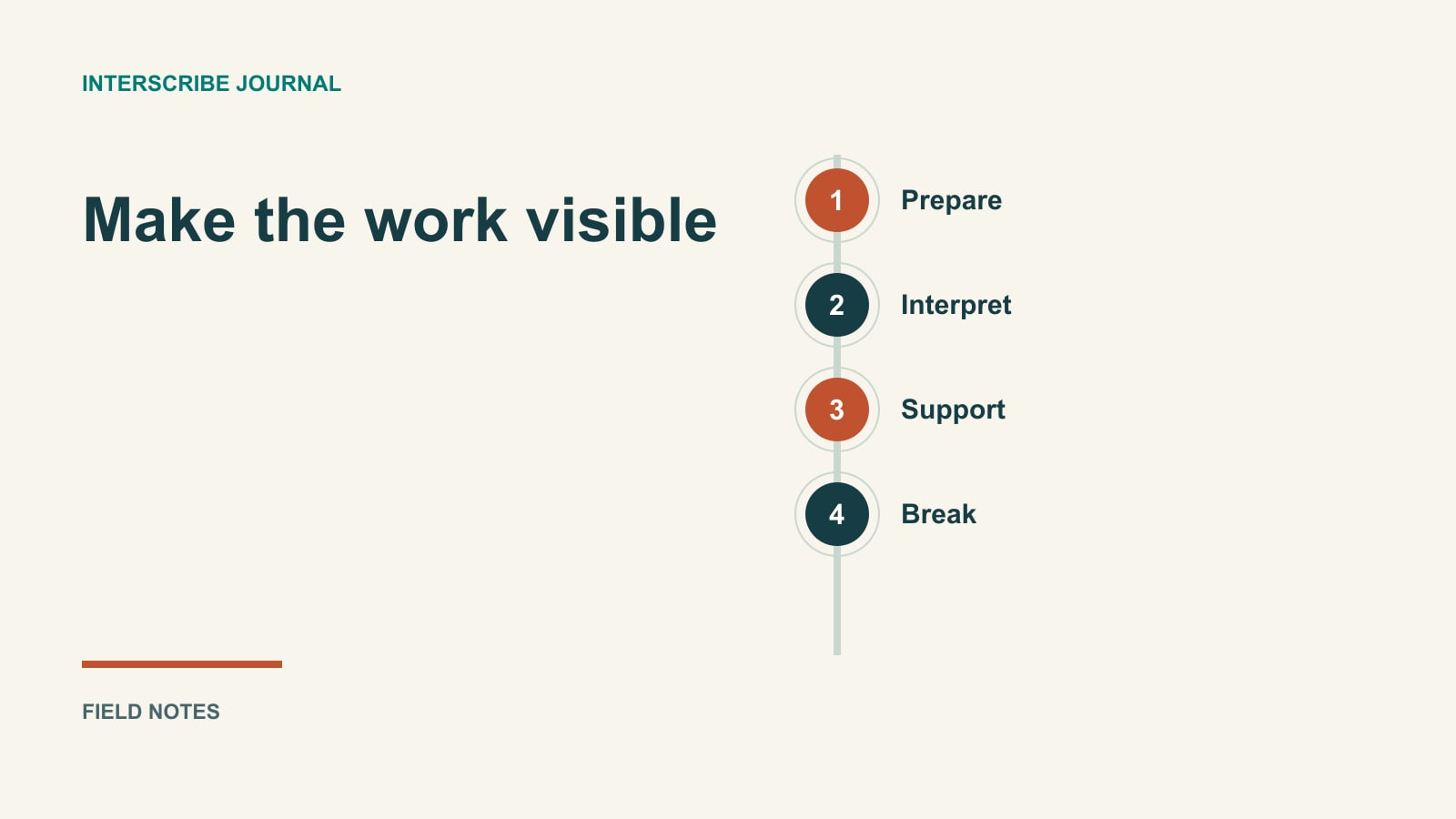
Put the whole assignment on the schedule
An agenda can show a short presentation while hiding hours of preparation, technical setup, partner support and follow-up. If those activities are invisible, the organizer cannot make a realistic staffing plan with the interpreters.
This is a workload-planning guide, not a clinical assessment of burnout or a universal prescription for shift lengths. Its purpose is to help organizers and interpreters agree on the actual assignment, identify uncovered work and decide what needs to change before the event.
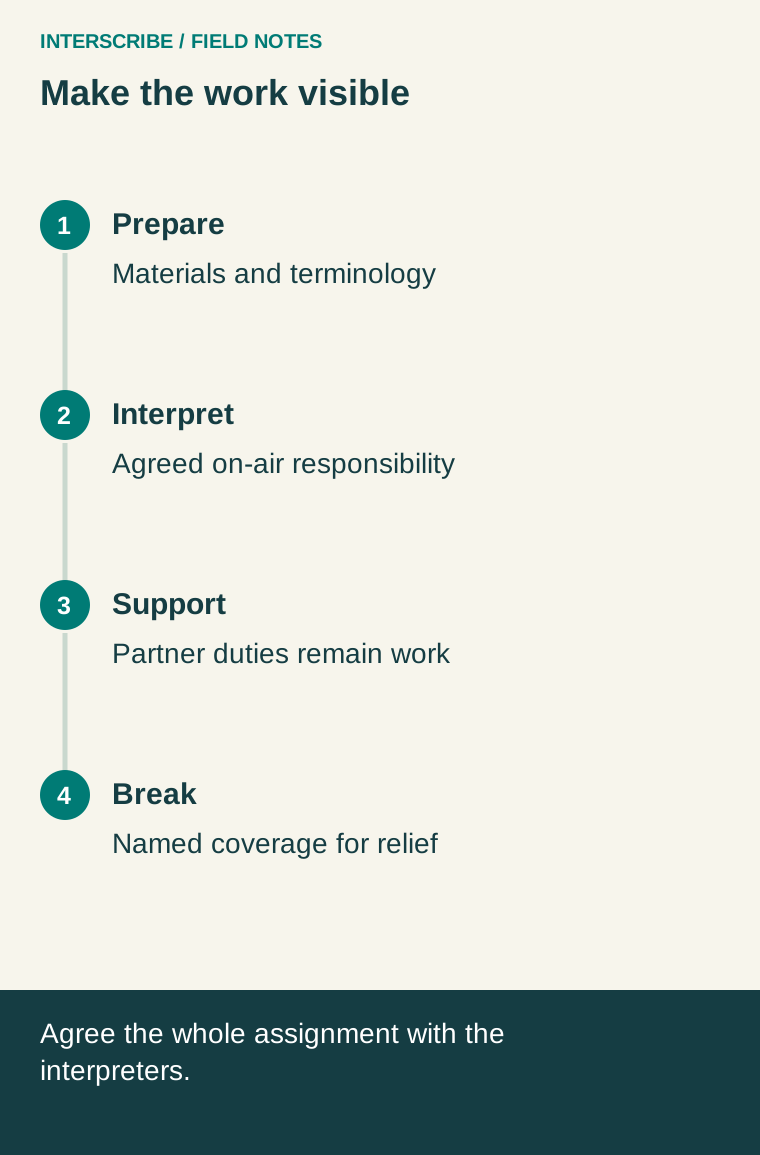
Start with professional judgment, not a timer
The AIIC professional framework links working conditions with interpreting quality and interpreters' health and safety. Use the applicable professional standards and the assigned interpreters' judgment when agreeing on staffing and conditions.
A convenient number copied from another event is not an assignment assessment. Discuss the languages and directions, simultaneous or consecutive format, subject matter, speaker pace, audio conditions, relay arrangements, concurrency and total working day. Include local start and finish times for remote team members.
A partner listening, tracking terminology or preparing a handover may still be working. Do not label that period a break simply because their microphone is closed. The plan should identify who covers each necessary responsibility while another person is genuinely relieved of it.
A fictional agenda that reveals hidden work
Consider a fictional association seminar. Its public program contains a presentation, a pause and a discussion. The first staffing draft assigns two interpreters to alternate speaking segments, then asks both to troubleshoot participant audio during the pause.
At the planning meeting, the interpreters point out that the pause contains another task. They also need the speaker's technical vocabulary in advance, and the discussion may continue beyond its advertised finish. The team does not solve this by declaring one rotation interval “safe.” It revises ownership and agrees the working arrangement with the interpreters.
| Program phase | Work to make visible | Agreed planning response |
|---|---|---|
| Before the day | Read materials, resolve terms, test equipment | Supply materials by an agreed date and schedule preparation |
| Presentation | Interpret, monitor, support the partner | Agree team roles and handover signals |
| Public pause | Audience support requests and equipment questions | Assign a separate technical support person |
| Discussion | Unscripted questions and possible overrun | Moderator enforces the agreed finish and escalation plan |
The resulting coverage sheet is the useful output. It does not claim that a particular duration prevents fatigue or that this staffing pattern fits every assignment.
Build the workload sheet together
Use one row for each working period and each person. Include adjacent commitments where the individual chooses to disclose what is relevant; the organizer does not need private medical details or a complete personal calendar.
| Field | Question to settle |
|---|---|
| Task and local time | What work happens, and when for this team member? |
| Preparation | Which materials and terminology are needed, and by when? |
| On-air responsibility | Which language direction and segment are assigned? |
| Supporting responsibility | Who monitors, supplies terms or handles relay? |
| Relief and coverage | Who takes over each duty during the agreed break? |
| Technical support | Who resolves equipment or participant problems? |
| Change authority | Who may extend the program or change the arrangement? |
| Escalation | How can someone request relief or a pause privately? |
Leave unresolved rows visibly unresolved. A blank coverage cell is a planning problem, not permission to expect whoever is available to absorb it.
Reduce avoidable work before adding another session
Ask presenters for usable materials, not just a slide deck arriving as they begin. Flag terminology, proper names, quotations and planned videos. Identify which materials may be shared with the team and how long they should be retained.
Design the question process with the interpreters. A host who manages one speaker at a time and repeats an unamplified question can make the source easier to follow. Test the actual microphone path, including audience questions and video playback, rather than only the opening greeting.
Keep technical support separate from language work where the agreed arrangement requires it. “The interpreter knows the platform” is not a reason to make that person simultaneously responsible for the audience help queue.
For remote work, agree what happens if the source becomes unusable. The response might involve a host pause, a microphone correction or another agreed arrangement. It should not require an interpreter to guess missing content or silently continue under changed conditions.
Rehearse the handover and the relief request
A handover rehearsal should establish who is active, how the incoming interpreter confirms readiness, and how the outgoing interpreter knows the change happened. Include an unsuccessful handover in the practice: the next person does not respond, or their microphone is unavailable. The team should know who communicates with the host.
The InterScribe booth audio guide documents microphone and headphone checks, private sound testing and floor or relay listening. Use those documented controls to support the agreed workflow, then verify the actual environment. Learning a control does not replace professional preparation or an assignment-specific staffing agreement.
Also practice a discreet request for relief. A useful message identifies the operational need—“source audio is unusable” or “the agreed finish has passed”—without forcing someone to disclose private health information in a public channel.
Debrief without turning wellbeing into a score
After the event, ask what differed from the plan: late materials, additional languages, difficult audio, an overrun, missing coverage or support requests during a break. Give people a private way to respond. Do not infer a person's health from caption errors, output volume or whether they complained publicly.
Record actionable changes with owners. For example: “The moderator will enforce the discussion cutoff,” or “The producer will send cleared technical terms before rehearsal.” Avoid a vague instruction for interpreters to become more resilient when the problem was an unstaffed task.
Before accepting the next event, compare its assignment with the repaired plan. More sessions, a new language direction or a changed time zone can require a new agreement. The takeaway is a shared workload record that makes coverage and limits visible, so a successful event does not depend on invisible extra work.