
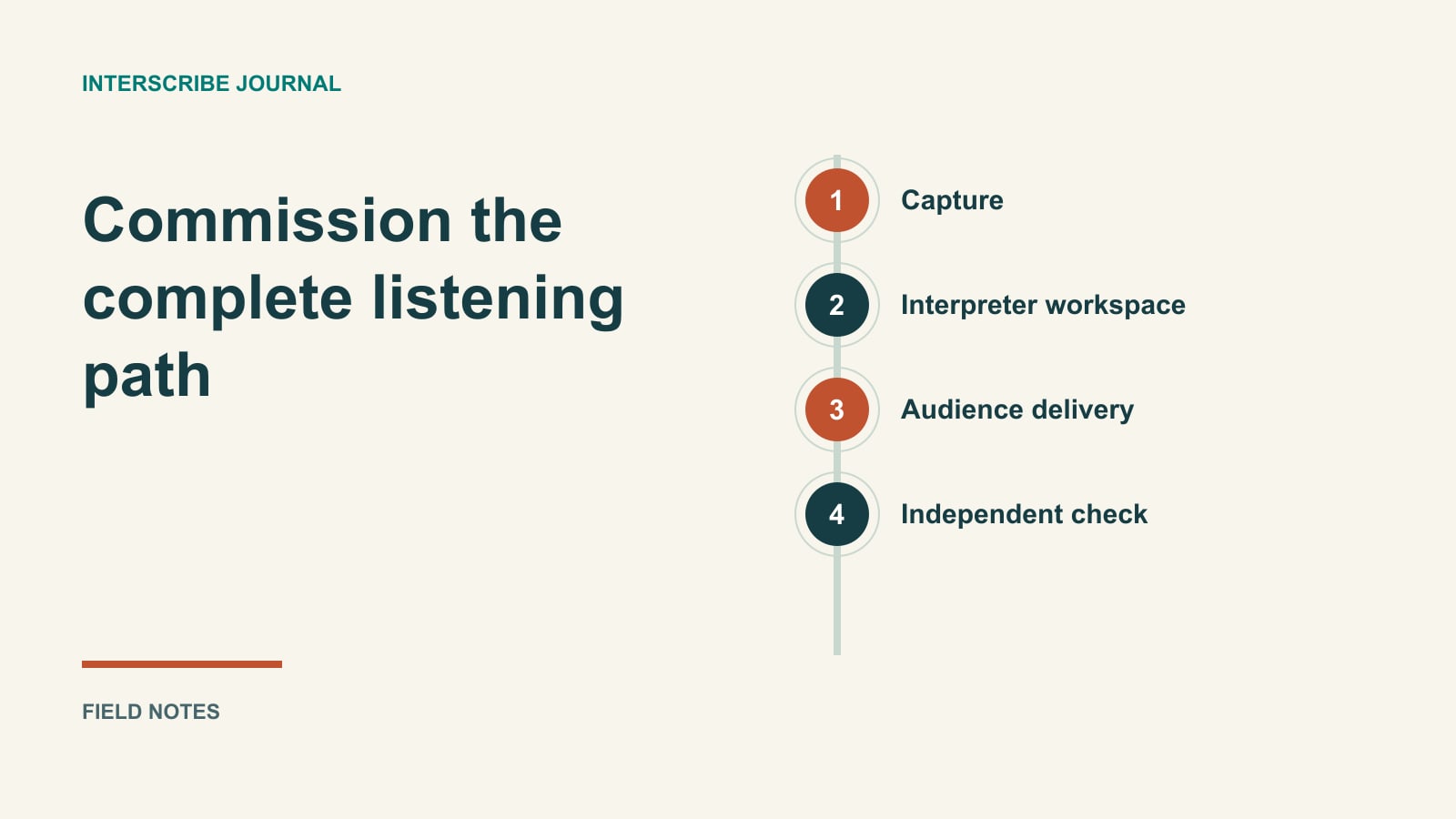
The interpreter can hear the presenter. The audience can hear the interpreter. Then a remote panelist speaks, and the interpreter hears silence.
The equipment list looked complete because it named microphones, headsets, and a computer. What it omitted was the path connecting each contributor to each person who needed to hear them. Specify that path before ordering equipment or committing to a delivery system.
This guide is a commissioning brief for the producer, AV lead, and interpreting provider. It does not certify equipment against a standard or replace a qualified technical design. The required configuration depends on the event, language directions, venue, and agreed communication arrangement.
Choose the configuration before counting devices
On-site interpretation with dedicated audience receivers: interpreters work in an agreed physical workspace, hear the source through their equipment, and send interpreted channels to a distribution system. The supplier must specify room coverage, channel mapping, receiver handling, power, and support. Do not label a transmission method secure merely because it uses a particular medium; verify the actual security requirements and implementation.
Remote interpretation: interpreters work away from the event. Their source sound, relevant visual information, team communication, and return audio need explicit routes. A video meeting link alone is not a complete technical specification.
Browser-based audience delivery: attendees receive the offered audio on compatible connected devices. Device support, headphones, joining, network access, battery, and assistance become part of delivery. This may coexist with on-site or remote interpreters; it does not describe where the interpreter sits.
The AIIC professional FAQ discusses equipment in relation to interpretation mode and meeting structure, and directs clients to specialist advice. Use your interpreting provider and equipment supplier to establish the assignment's requirements. AIIC Asia-Pacific: interpreting FAQ.
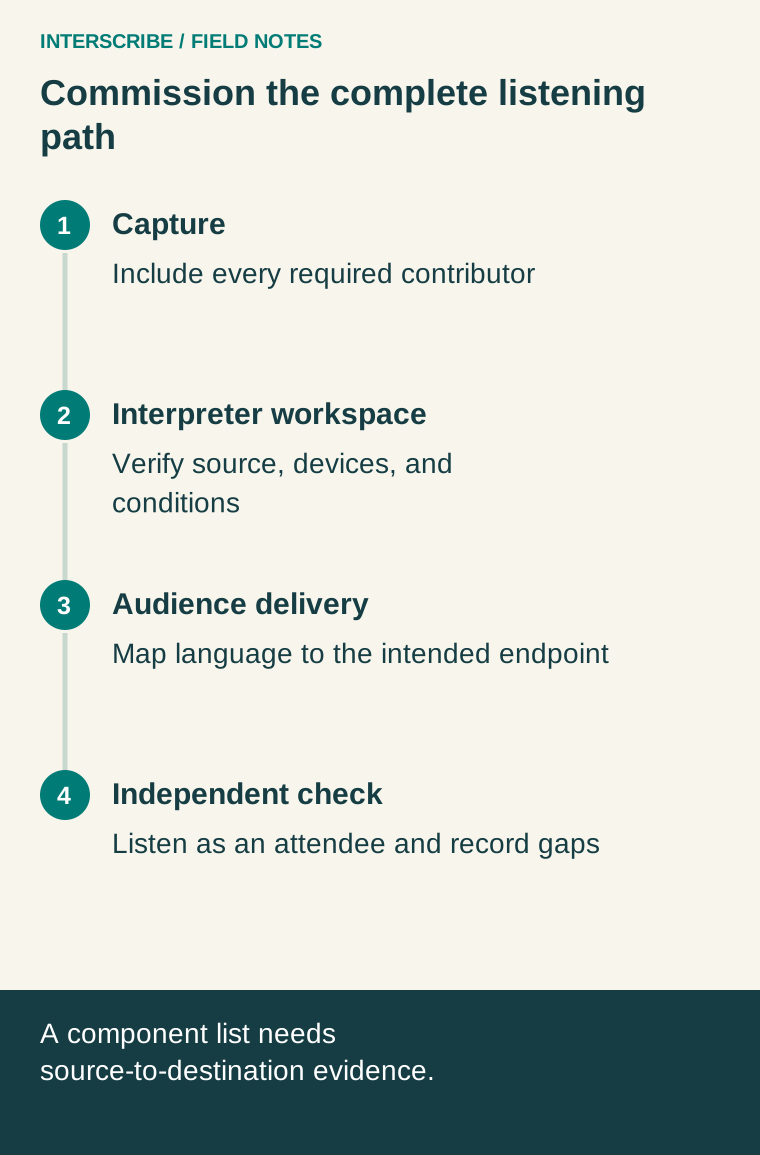
Draw four paths, including the one back
Write down the path for each required source:
- Contributor to interpreter: stage microphone, remote participant, media playback, or question microphone reaches the interpreter's selected listening feed.
- Interpreter to audience: interpreter microphone reaches the correct language channel and intended attendee device or receiver.
- Participant contribution back to the event: a question or response reaches the moderator, relevant interpreters, and other participants through the agreed arrangement.
- Monitoring and coordination: operators can check delivery, and interpreters can coordinate handovers or report trouble without placing private coordination in audience audio.
Keep the room reinforcement, interpreter return, and monitoring paths distinguishable. Ask the AV lead to prevent unwanted return audio and feedback in the design; do not improvise a mixer routing change during a live interpretation turn.
Also specify recording separately. A working live channel does not prove that the intended recording includes it or that recording is permitted.
Build a component-and-owner worksheet
| Component or service | Requirement to write down | Owner | Acceptance evidence |
|---|---|---|---|
| Source microphones and playback | Every required contributor reaches the selected feed | AV lead | Distinct test phrase from each source heard remotely |
| Interpreter workspace | Sound, sightlines/video, lighting, comfort, and team arrangements | Producer and provider | Interpreter confirms working conditions in rehearsal |
| Interpreter devices | Selected microphone, headphones, connection, and support route | Interpreter with technician | Private sound check and attendee channel test |
| Audience distribution | Languages, devices/receivers, coverage, joining, and assistance | Delivery lead | Intended attendee can choose and hear the channel |
| Power and network | Named dependencies and tested contingency | Venue/IT | Relevant rehearsal and documented response |
| Recording, if required | Which outputs, permission, storage, and review | Recording owner | Sample playback contains the intended material |
Add quantities, vendor references, rental or purchase terms, setup times, and spare arrangements only after the configuration is settled. Include staff labor and rehearsal in the bill of materials. A box of spare receivers is useful only if someone can distribute and test them.
A fictional hybrid routing problem
A fictional trade seminar uses an on-site presenter, a remote guest, and remote interpreters. Attendees in the room listen on their phones. During rehearsal, the presenter is clear in the interpreter's headphones, but the remote guest is audible only through the room speakers.
The technician traces the guest's return to the mixer and finds it absent from the feed sent to interpretation. The AV lead changes the planned routing during rehearsal, then checks the guest, presenter, question microphone, and media playback individually. Each source uses a different test phrase so a crossed or missing path is obvious.
A second tester listens to the interpreted channel from an attendee device. The team also checks that the interpreter's output does not return unintentionally to their own source feed. They document the final routing and label the relevant controls.
This is a fictional commissioning exercise, not a wiring instruction for every mixer. The repeatable method is to test each required source and destination, record the correction, and retest the affected paths.
Apply the documented InterScribe boundaries
For a room feed, the audio preparation guide documents an agent receiving the microphone or mixer input and sending to the room's AV channel. The session must use the intended room/source. Test audio can establish that sound arrives; a meter alone cannot prove intelligibility or complete source coverage.
For an interpreter, the Booth audio guide distinguishes the microphone listeners hear from the headphones carrying the floor or selected relay. The joining sound check is private. Confirm actual device selection before going on air.
The Booth does not play the interpreter's microphone back into their headphones. If self-monitoring is needed, the monitoring guide describes hardware sidetone or direct monitoring. That is separate from an end-to-end audience check. Monitor over headphones, not speakers, and agree suitable equipment with the technician and interpreter.
Changing a live microphone or microphone type can briefly interrupt output. Perform configuration and comparison checks in rehearsal, and follow the current support procedure for live faults.
Commission the operating procedure
Before acceptance, run a presenter change, remote contribution, audience question, interpreter handover, and break. Test the attendee joining instructions on an ordinary device. Where a session requires an access code, the documented route is the join page or portal with the event and access codes; direct links and QR codes are not equivalent. See how audiences join.
Confirm who may pause the event, who diagnoses each path, and how the interpreter reaches support. Agree staffing and breaks with the provider rather than imposing a generic duration rule. Retest after a relevant routing or device change.
Captions may be part of the event, but they do not automatically replace an arranged audio service. Keep the service-selection brief beside the equipment plan so technical simplification does not quietly change what participants were promised.