
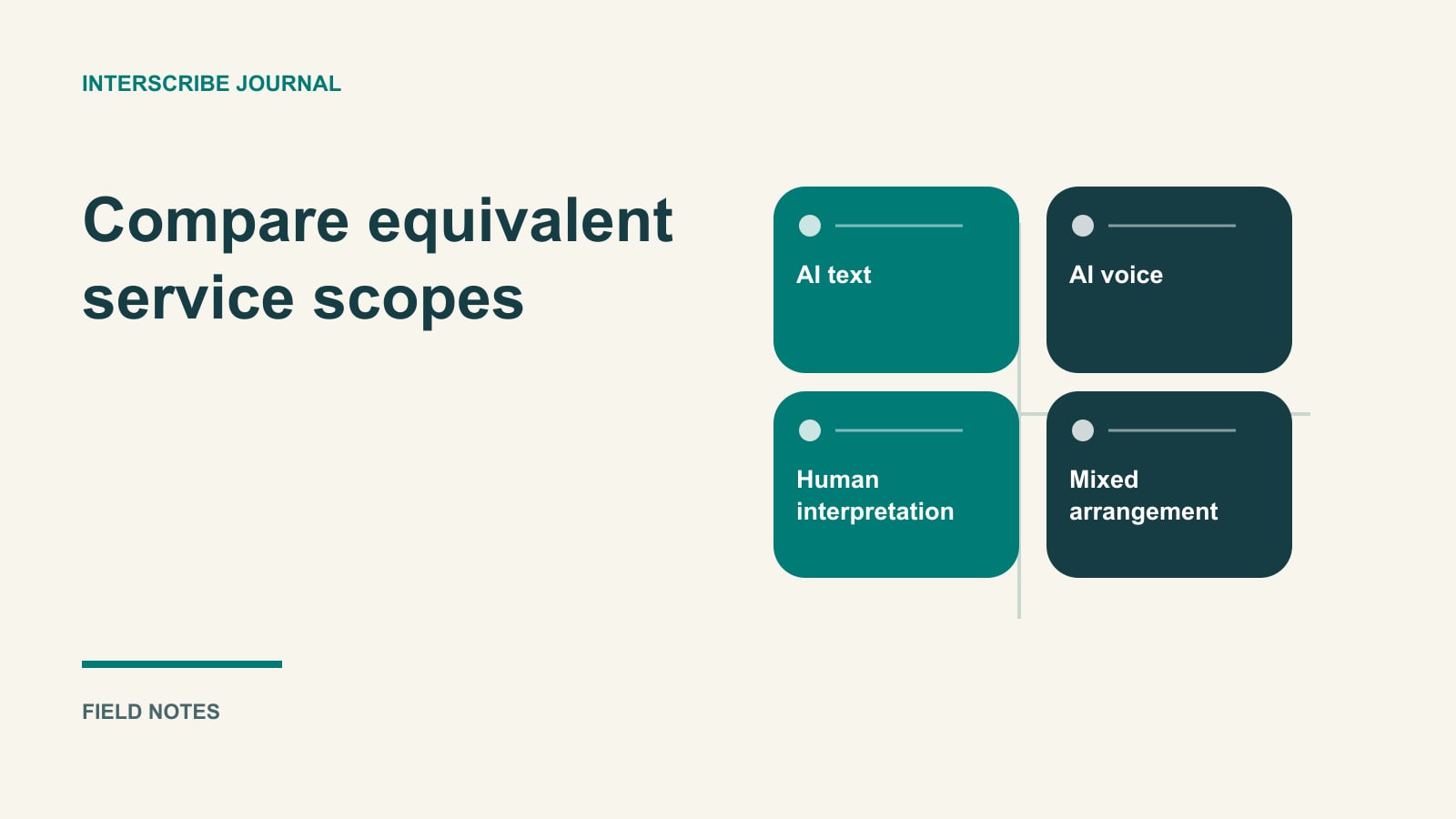
Two suppliers quote for a “multilingual event.” One includes translated text. The other includes interpreters, preparation, and a technician. The totals look very different because the services are different.
Before comparing prices, write down what participants must be able to do. Receiving a presentation, negotiating a disputed term, asking a question, and reading a document are not interchangeable tasks. The service brief should name those tasks, the communication methods people need, and who will judge whether the proposed arrangement works.
This guide helps you compare options fairly. It does not assign every conference to AI or every consequential discussion to a single universal service category. Relevant professional, institutional, and legal requirements need their own assessment.
Put the actual alternatives on the page
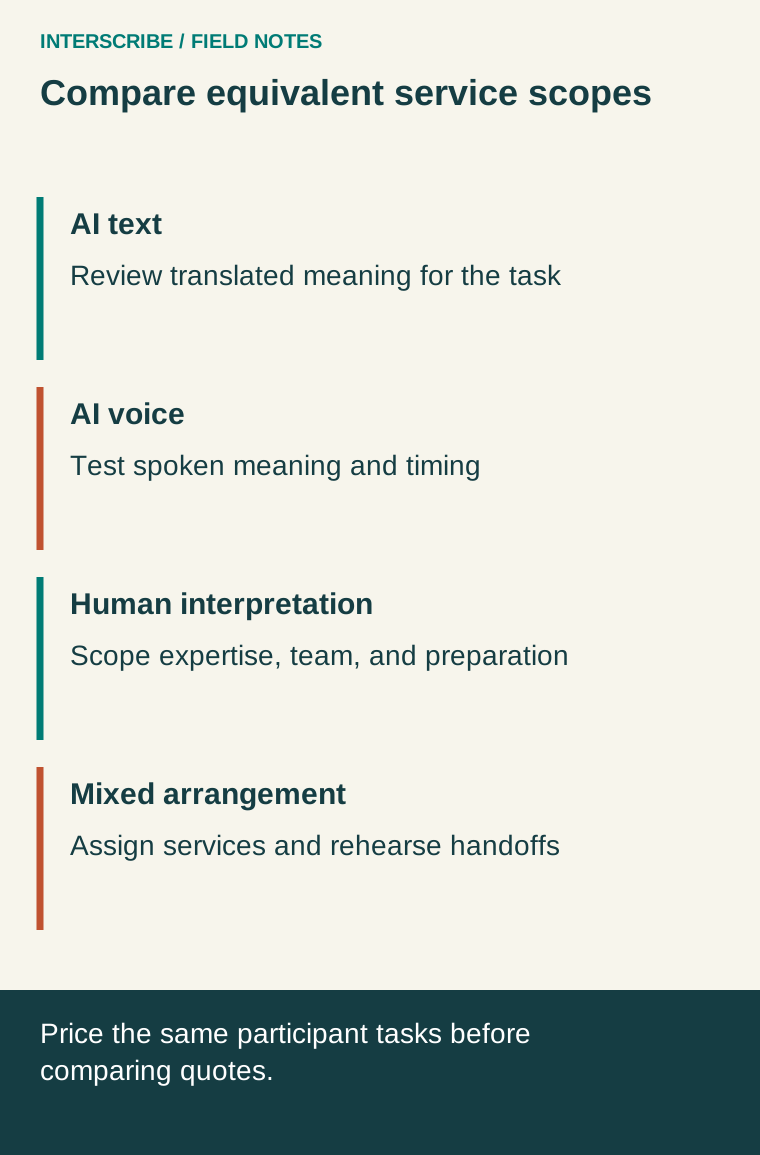
AI translated text turns captured speech into a written translation for attendees to read. Evaluation needs to consider both the source recognition and the translated meaning. An error in the captured words can affect the output, while correct source words still do not establish correct translation.
AI voice delivers synthesized spoken interpretation. It needs its own listening test. Do not treat an attractive voice as evidence that terminology, intent, or timing is correct.
Professional human interpretation is a service performed by people with the relevant language combination and subject competence. It can be arranged on site or remotely. Preparation, team coordination, sound, visibility, and working conditions belong in the procurement scope.
A mixed arrangement assigns different services to explicit tasks or audiences. It needs a handoff plan. Adding AI and human services to the same event does not by itself create an automatic or effective backup.
InterScribe documents AI voices separately from human interpreted languages. Confirm your account's available options and the intended workflow. A platform channel is not a booked interpreter or a qualification check.
Compare evidence, not category promises
| Question | AI text or voice proposal | Human interpretation proposal | Mixed proposal |
|---|---|---|---|
| Who receives what? | Named text/audio outputs and languages | Language directions and delivery method | Explicit assignment by segment and audience |
| How is meaning checked? | Representative sample reviewed by competent people | Relevant expertise, preparation, and rehearsal | Review of each service plus transitions |
| How do questions return? | Separate supported contribution route | Agreed receptive and expressive workflow | Named moderator and routing procedure |
| What happens during interruption? | Tested supported alternative or pause | Staffing and technical contingency | Authorized switch with participant communication |
| What is in the quote? | Account usage, setup, support, review | Team, preparation, equipment, support, terms | All components and coordination time |
Ask every bidder to respond to the same program and assumptions. A service that omits the question period cannot be compared directly with one that covers it. A quote without review time should not be presented as the total cost of reviewed multilingual materials.
Use consequences to set the evaluation
Identify what happens if a phrase is wrong, late, or missing. In a general presentation, the response may be clarification before moving on. In an employment decision, medical interaction, legal proceeding, or safety instruction, the responsible qualified owner must determine appropriate arrangements and verification.
Avoid making a simplistic rule from the event label. A “casual workshop” may contain a consequential instruction. A large keynote may contain less interaction than a small technical meeting. Map the segments rather than assuming room size determines the service.
Use realistic examples: a negation, a correction by the speaker, a name, an unfamiliar term, and a question that refers back to a slide. Agree what would make the proposal unacceptable before watching a polished demonstration.
A fictional procurement decision
A fictional trade association is planning a product briefing and a separate member discussion. Attendees have requested French spoken interpretation for the discussion; several also want written terminology during the briefing.
Supplier A offers AI text and voice for the briefing. Supplier B offers a professional interpreting team for both segments. The association asks both for a complete scope rather than selecting the lower initial number.
A representative briefing trial shows that the organizer needs more preparation for product abbreviations and a clearer method for participants to ask questions. A competent reviewer records the issues; the team revises the source material and repeats the relevant trial.
For the member discussion, the association keeps the requested human service and arranges its two-way participation route. It considers AI text as a supplementary reference for the briefing, subject to the tested result and access lead's assessment. The final brief names the transition, moderator, preparation deadline, and interruption procedure.
This is an illustrative decision process, not a real customer result or a claim that one arrangement is suitable for every association. The useful outcome is a scope that a supplier can price and a participant can understand.
Include the people doing the work
Ask the interpreting provider to propose team composition, breaks, handovers, technical support, and preparation requirements for the actual assignment. Do not invent a universal duration threshold or expect the person interpreting to troubleshoot attendee devices at the same time.
AIIC's regional professional guidance discusses preparation and team requirements and recommends consulting an interpreter about the assignment. Use it as professional context, then agree the details with your provider. AIIC Asia-Pacific: interpreting FAQ.
Supply the agenda, language directions, terminology, speakers, and materials in the agreed timeframe. Arrange confidentiality and access to preparation material through your normal organizational process. Schedule a rehearsal that includes the interpreter's actual sound and visual conditions.
Copy this procurement brief
Complete these fields before requesting final quotes:
- Participant task: What must people receive, contribute, or decide?
- Communication arrangement: Requested languages and methods, including distinct reading and listening needs.
- Program: Segments, duration, simultaneous rooms, breaks, and interaction.
- Consequences: Examples of important errors and the authority assessing the arrangement.
- Inputs: Microphones, remote contributors, slides, terminology, and preparation dates.
- Evidence: Representative sample, competent reviewers, observed barriers, and retest criteria.
- People: Operator, interpreting team, moderator, access lead, and backup contacts.
- Commercial scope: Usage assumptions, setup, staffing, review, cancellation, and changes.
- Interruption plan: Who pauses or changes delivery, how attendees are told, and what remains usable.
- Acceptance: Named decision-maker, evidence required, and unresolved limitations.
Preserve the brief with the accepted quote. Revisit it if the agenda, language directions, or audience changes. For the next implementation step, use the attendee audio-and-text comparison and interpreter equipment plan. Good procurement ends with a testable service, not a verdict that either people or software always wins.