
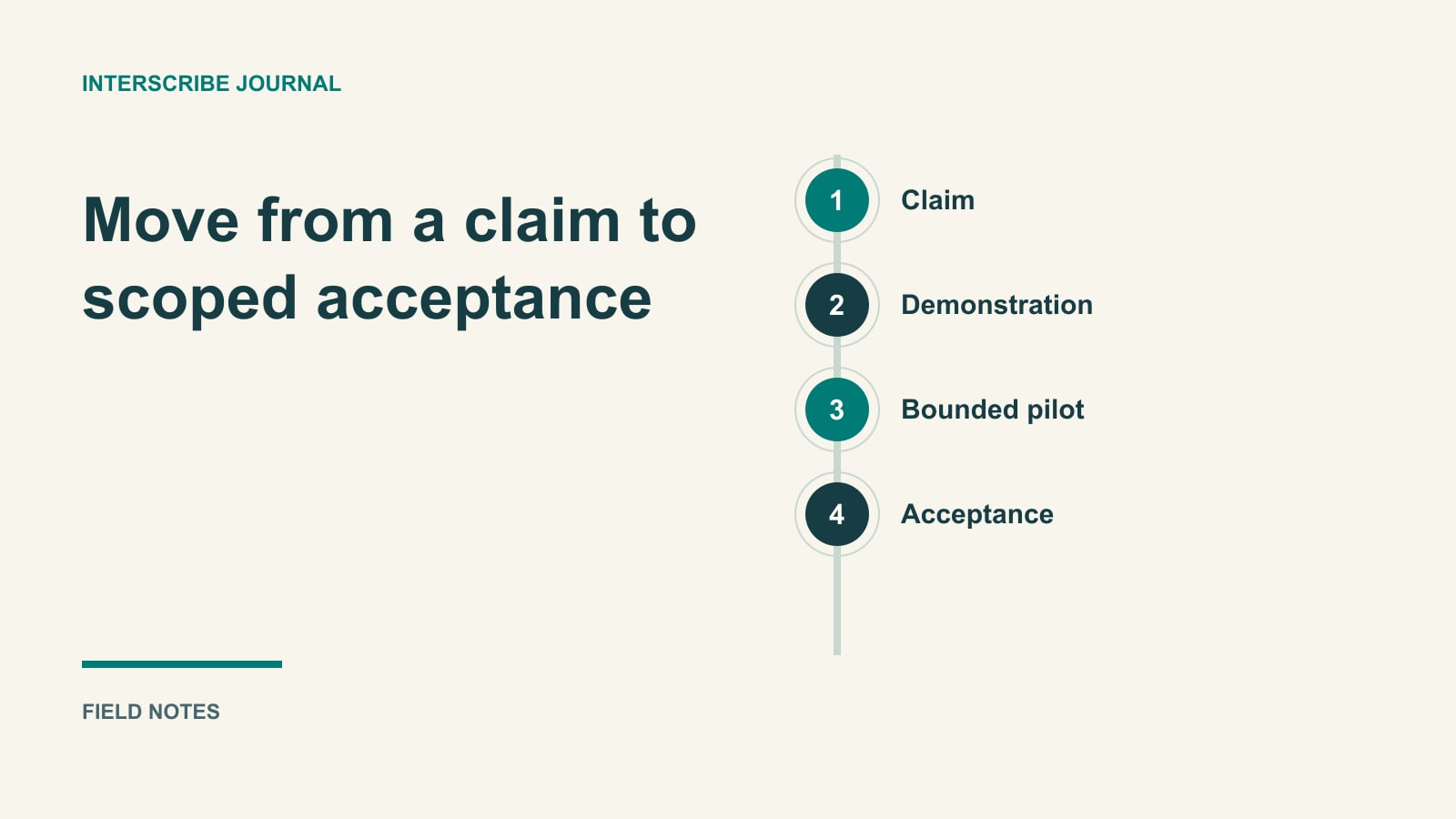
A supplier's roadmap promises more languages, simpler delivery, and less equipment. Your next event already has a date. Which capabilities can you responsibly include in the participant invitation?
Treat the “future of interpretation” as a procurement and readiness question. Keep a record of what is documented, what you have tested, what remains conditional, and what the event actually needs. That record is more useful than a prediction that one delivery model will replace another.
This guide helps you evaluate a change without turning a roadmap into a commitment to attendees. It makes no forecast about adoption, prices, quality improvements, or future product releases.
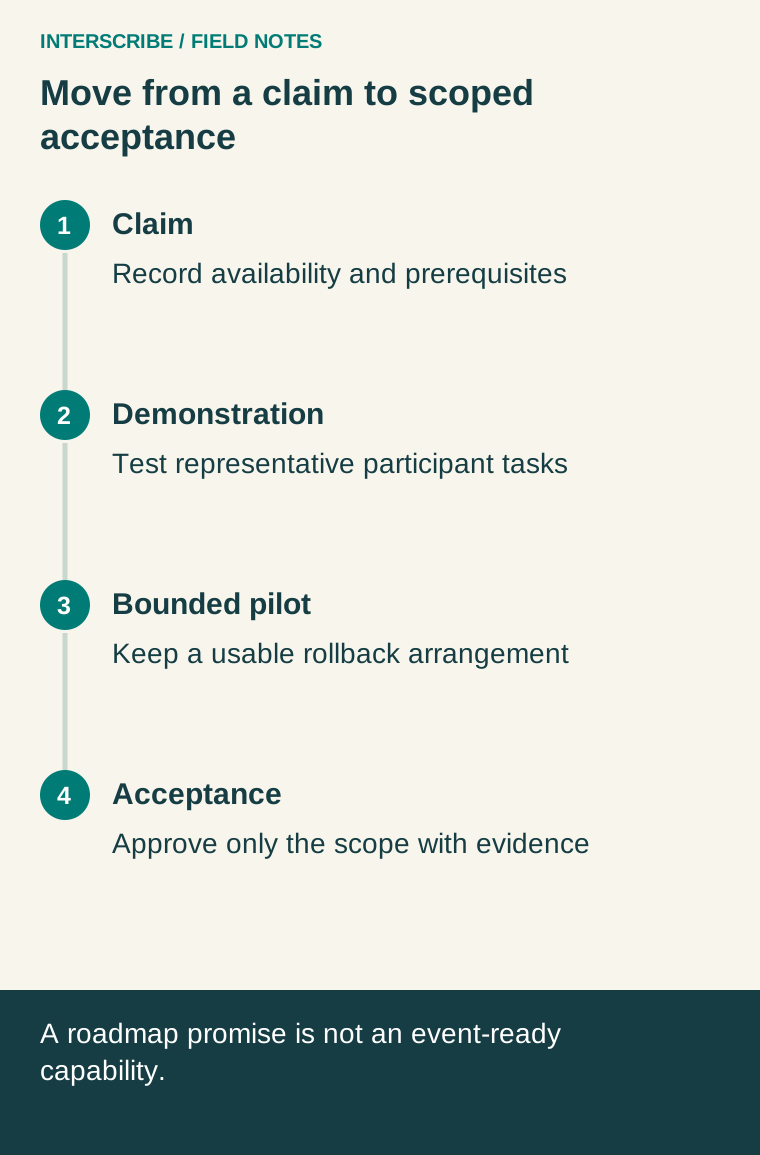
Separate four evidence states
Use explicit labels in the purchasing file:
| State | Evidence you have | Appropriate planning use |
|---|---|---|
| Claimed or planned | Sales statement or roadmap | Question for the supplier; not promised coverage |
| Documented for the account | Written scope, prerequisites, and availability confirmation | Candidate for a representative demonstration |
| Tested in stated conditions | Recorded tasks, environment, result, and limitations | Candidate for the approved pilot scope |
| Accepted for this event | Responsible owner approves the tested arrangement | Include the specific service in the event plan |
These states are your team's evidence labels, not product status badges. A documented feature can still fail your task. A successful demo on one language and device does not validate every combination. An accepted arrangement can require reassessment when the event changes.
Write the capability as a participant task
Replace “supports multilingual events” with something testable: “A remote attendee can follow the technical presentation in the requested spoken language, ask a question through the agreed route, and hear the answer.”
State the language directions, media, devices, and simultaneous rooms. Include the support conditions: operator availability, interpreting team arrangements, network dependencies, and preparation material. Keep the attendee's chosen communication method intact when comparing old and new delivery.
If the proposed change removes equipment, identify what takes its place. Replacing receivers with phones may change distribution work, but introduces or shifts dependencies involving networks, compatible devices, headphones, charging, and assistance. Fewer boxes do not establish fewer overall failure modes.
Request a demonstration that can fail
Give the supplier a representative brief in advance and agree which tasks you will observe. Include realistic terminology, a speaker correction, a question, and a transition. Use non-sensitive sample material unless appropriate permissions and handling arrangements are in place.
Ask the supplier to show the intended account and configuration. If it uses a special demonstration environment, record the difference. Distinguish features that are included, separately enabled, constrained by usage, or still proposed.
Do not accept a claimed automatic fallback without seeing its configured behavior and limitations. Ask what triggers it, what participants see and hear, what may be lost, and who can intervene. Rehearse interruption behavior safely outside a live event; do not disrupt production to prove a sales claim.
A fictional migration pilot
A fictional association uses dedicated receivers for a recurring seminar and is considering browser delivery for part of the audience. The purpose is to test an alternative distribution route, not to replace the professional interpretation service.
The team documents the current participant task and arranges a rehearsal with the interpreting provider, AV lead, and volunteer testers. One tester has no suitable headphones. Another cannot use the proposed network. The team adds an equipment/help arrangement and verifies the permitted network route before expanding the trial.
During a subsequent test, the moderator changes to a discussion format that was absent from the initial demo. The organizer adds that segment to the acceptance scope and checks the question path. The pilot therefore produces a narrower decision: use the new route only for the tested conditions, maintain the agreed alternative for other participants, and leave an untested room on its established arrangement.
This fictional example demonstrates a bounded migration decision. It is not evidence of cost savings, equivalent performance, or an endorsement of removing receivers from all events.
Copy this vendor demonstration scorecard
| Capability claim | Evidence to request | Your task test | Decision record |
|---|---|---|---|
| Requested language output | Account availability and exact text/audio distinction | Representative meaning reviewed in that output | Pass, revise, or not tested; reviewer named |
| Attendee delivery | Supported devices and joining conditions | First-time participant joins and changes selection | Device/environment and observed barrier |
| Human service integration | Roles, language assignment, and handover workflow | Interpreters rehearse actual team coordination | Provider acceptance and unresolved needs |
| Interruption response | Documented behavior and support responsibility | Safe rehearsal of agreed contingency | Trigger, action, usable alternative, owner |
| Post-event output | Format, permissions, and review responsibilities | Intended recipient opens correct sample | Version and publication approval |
Avoid a single weighted score that lets several convenient features cancel a blocked essential task. Mark essential requirements explicitly. An unresolved essential requirement should remain visible to the person deciding whether to proceed.
Use product documentation as a starting point
For InterScribe, consult AI voice configuration, human interpreter setup, and attendee language choices. These describe different services and workflows; check what your account actually offers before preparing invitations.
For example, a text language choice is not proof of the same spoken output, and a human interpretation channel does not book a provider. Confirm staffing, usage assumptions, preparation, and support separately. For the service comparison itself, use the AI and human procurement guide.
Record the documentation date or version used and any supplier clarification. If a promised capability is missing, keep it in the claimed/planned state instead of rewriting the test to avoid it.
Define the pilot boundary and rollback before launch
Write a small pilot charter: event and audience, candidate configuration, essential tasks, responsible owner, rehearsal evidence, supported alternative, decision time, and stop conditions. Agree the plan with participants and service providers through the appropriate process.
A rollback must be usable. Specify who changes delivery, how attendees receive instructions, what content may be missed, and whether the host pauses. Do not use “switch to captions” as a universal fallback for people who need another method.
After the pilot, compare observations with the acceptance criteria. Retain raw issues and limitations alongside positive feedback. Accept only the scope actually tested, and schedule a review when a relevant dependency changes. That lets the team adopt useful capabilities while keeping future promises separate from the service it can deliver at the next event.