
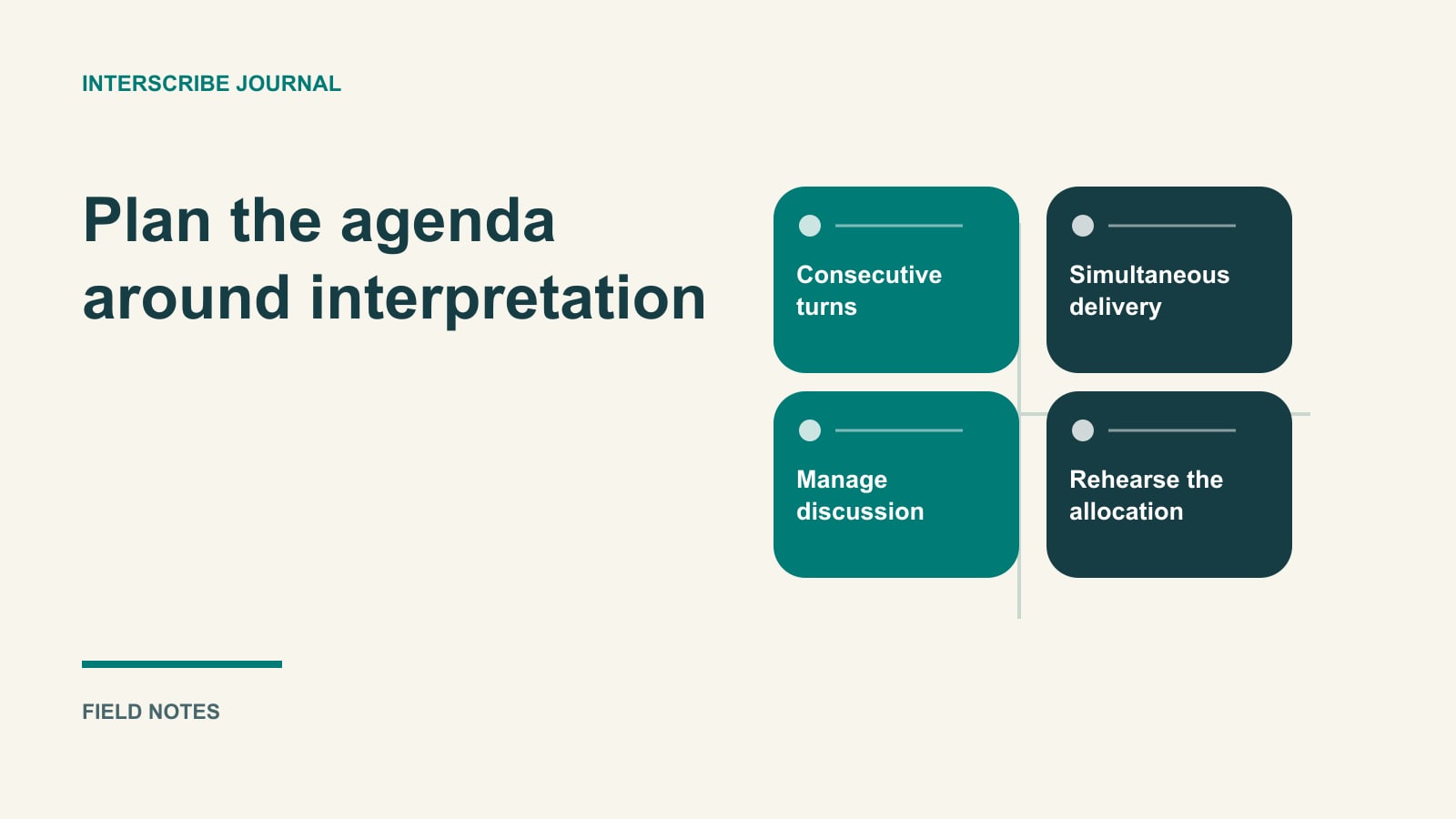
An event can fit neatly into an hour until somebody asks where the interpretation fits. If the answer is “the interpreter will keep up,” the agenda is not finished.
Consecutive and simultaneous interpretation organize speaking time differently. Choosing between them is an event-design decision involving interaction, preparation, sound and the people doing the work. It is not a choice between needing skill and avoiding it.
Understand the difference in the room
In consecutive interpretation, the speaker delivers a segment and pauses while the interpreter conveys it. Participants take turns. The appropriate segment length depends on the assignment and interpreter; agree it in preparation rather than assuming the speaker should pause after every sentence.
In simultaneous interpretation, the interpreter listens and conveys the message while the speaker continues, usually with listeners receiving a separate language channel. The interpreter still needs preparation, working conditions and a suitable team arrangement. A headset or software channel does not provide that competence.
The AIIC overview of interpreting describes the formats and the importance of discussing requirements with interpreters. For your event, ask the practitioners to review the programme and working arrangement before you promise a format to attendees.
Compare the interaction you actually want
| Event need | Consecutive planning question | Simultaneous planning question |
|---|---|---|
| Short welcome or announcement | Where can the speaker pause naturally? | Is a separate listening route worthwhile for this segment? |
| Long prepared presentation | What content must be reduced to include interpreted turns? | Can the team receive materials and a reliable floor feed? |
| Small discussion | Who manages each turn and the language direction? | Can every contribution reach the interpreter clearly? |
| Audience questions | How will the chair hold the floor until the interpreted question finishes? | How will microphones and any direction changes be handled? |
| Sensitive or specialist content | Who has the appropriate interpreting competence? | Who has the appropriate interpreting competence? |
The final row is deliberately the same. A slower format is not permission to assign a demanding conversation to an unprepared bilingual colleague. Use the role acceptance card when considering staff or volunteers.
Fictional example: two versions of a workshop
Imagine a community organization with a 60-minute room booking and an English presentation for an audience that also needs Spanish. These are fictional planning allocations, not measured performance or universal timing rules.
Version A: consecutive workshop
| Segment | Proposed allocation | What the organizer must change |
|---|---|---|
| Welcome and turn-taking explanation | 5 minutes | Explain that each message will be interpreted before the next turn |
| Presentation with interpreted pauses | 30 minutes | Reduce the source presentation and rehearse segment boundaries |
| Questions with interpreted turns | 20 minutes | Chair selects fewer questions and allows both language directions |
| Summary and joining the follow-up | 5 minutes | Use a short prepared closing message |
Version B: simultaneous workshop
| Segment | Proposed allocation | What the organizer must arrange |
|---|---|---|
| Welcome and listening check | 5 minutes | Explain the language route and offer help |
| Presentation | 30 minutes | Prepare interpreters and maintain the floor feed |
| Questions | 20 minutes | Capture every question on a microphone and manage turns |
| Summary and follow-up | 5 minutes | Keep interpretation available through the closing instructions |
Both versions occupy an hour, but they do not contain the same amount of source speech. Version A requires a shorter presentation. Version B has additional listening and technical requirements. Neither allocation becomes credible until the speaker, chair and interpreting team rehearse a representative section.
Do not calculate consecutive time by applying a guaranteed multiplier to every programme. Speech density, languages, interaction and segment length affect the plan. Record the rehearsal observation and leave room for the event’s actual needs.
Use an agenda acceptance worksheet
Before invitations go out, answer these questions in one shared document:
- Outcome: What should attendees be able to understand or do afterward?
- Source material: What can be shortened without losing that outcome?
- Language directions: Which languages will speakers and questioners use?
- Delivery: Which segments use consecutive or simultaneous interpretation?
- Preparation: Who sends slides, terminology and revised passages, and when?
- Working arrangement: What team, relief and conditions have the interpreters agreed?
- Floor management: Who can pause the speaker or repeat an unheard question?
- Failure decision: Who chooses a pause, a shorter segment or another agreed alternative?
Keep a visible “not yet agreed” field. It is better to resolve an uncertain discussion format before publishing the programme than to discover it while an audience is waiting.
Rehearse questions, not only the opening speech
A presentation rehearsal can sound excellent while the real discussion fails. Ask a colleague to pose a question from the back of the room. Require the chair to wait for the microphone. Include a clarification request and a speaker who starts answering too soon.
For consecutive delivery, the chair should protect the interpreter’s turn. For simultaneous delivery, the chair still needs to prevent overlapping contributions and ensure the floor contains the question. Tell participants what will happen before asking for the first question.
If the programme changes format midway, explain the transition. “For this discussion, we will pause after each contribution for interpretation” gives everyone a workable expectation.
Connect the format to the platform
InterScribe’s human interpreter setup describes configuring interpreted languages and inviting interpreters where the feature is available. The Booth guide explains selecting a channel, opening a microphone and handing it over. These are delivery controls; the event team still owns staffing and programme decisions.
Test the listener’s language selection, the interpreter’s floor feed and the actual question microphones. Follow booth audio setup and agree who starts the session. A working microphone check is not proof that the complete discussion format works.
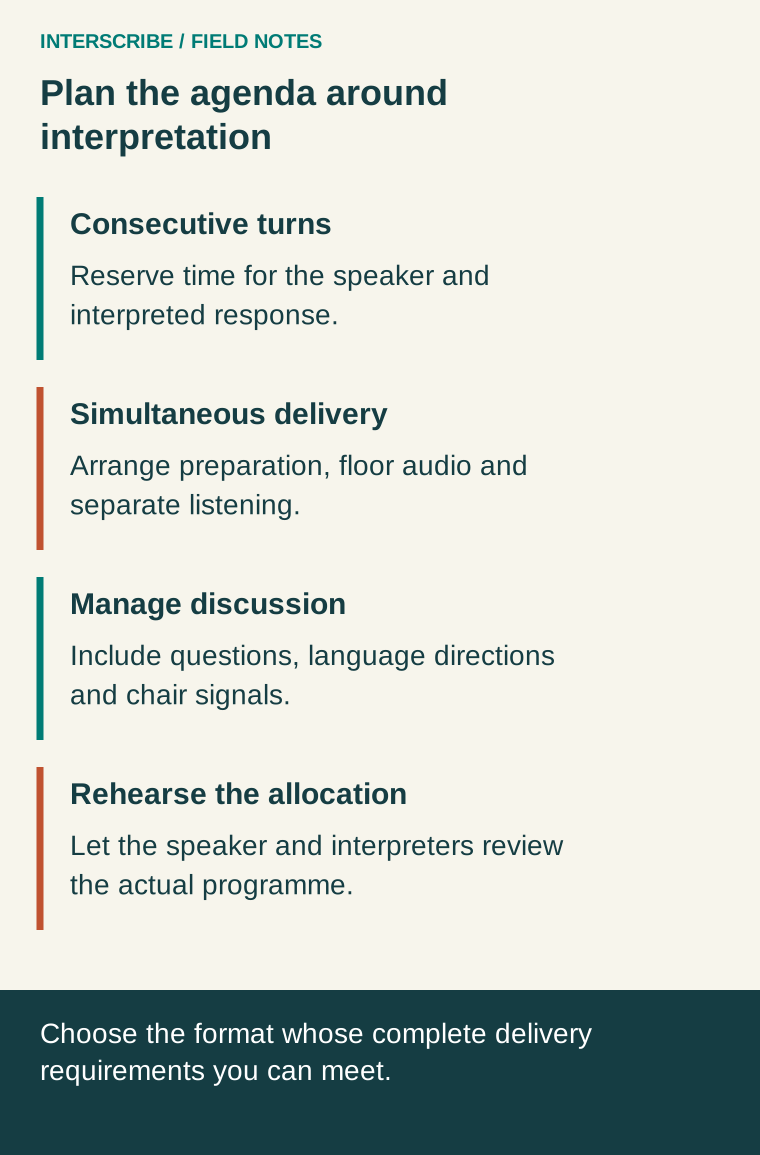
Choose the version whose preparation and delivery requirements you can meet. A shorter, well-managed interpreted workshop is more useful than a full agenda whose audience cannot follow the discussion.