
Your reachable audience matters more than a global total
A worldwide conference-market estimate can be interesting context. It does not establish how many people will register for your event, which languages they prefer, or whether your team can support the experience you advertise.
For a practical decision, build an evidence trail from people you can reach to needs you can deliver on. This guide offers a planning funnel, a fictional capacity example and a worksheet for deciding whether an international pilot is ready. It makes no claim about the size or growth rate of the global conference market.
Separate four quantities
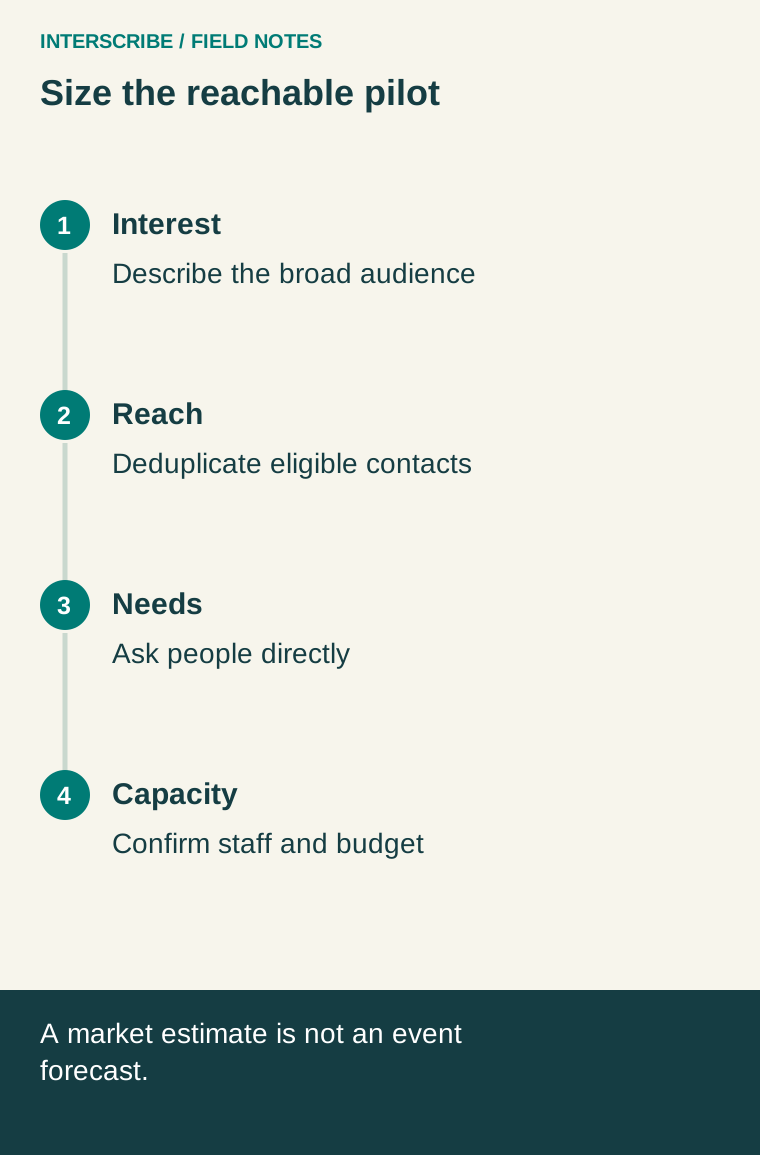
Broad interest includes the people who might care about the subject. A sector report may help describe that context, provided its geography, period, event definition and methods match your question.
Reachable audience means people you can actually invite through an appropriate channel: members, opted-in contacts or a partner's agreed distribution. A partner's total membership is not automatically your invitation list, and overlapping lists must not be counted twice.
Confirmed needs come from responses and conversations. Ask about preferred participation language, format, timing and the task people hope to complete. Nationality, company location and browser locale are poor substitutes for asking the participant.
Deliverable capacity combines seats or remote access with staffing, language services, support, materials and the budget for the specific program. Technical availability alone does not establish that the whole participant journey is ready.
A fictional association pilot
Suppose an association has 240 members who can appropriately receive an invitation. A partner identifies another 90 eligible contacts, 30 of whom overlap with the association list. The deduplicated reachable pool is 300: 240 + 90 − 30.
An interest form receives 60 responses. Of those respondents, 24 request Spanish support, 18 prefer English and 18 select another option or ask for a conversation. These are stated preferences among respondents, not a forecast of all 300 contacts or of registrations. The remaining 240 people have not supplied a preference through this form.
The organizer interviews several respondents and learns that the most requested task is asking questions about a technical demonstration. Translating only a promotional page would not address that need. The pilot therefore needs a plan for questions and answers, not just translated invitations.
| Planning stage | Fictional evidence | What remains unknown |
|---|---|---|
| Reachable audience | 300 eligible, deduplicated contacts | How many will read the invitation |
| Expressed interest | 60 form responses | Whether nonrespondents share the same interests |
| Language request | 24 respondents request Spanish support | Final registrations and individual arrangements |
| Deliverable pilot | One demonstration with a moderated question segment | Confirmed staffing, rehearsal and final quotes |
The team does not multiply the response rate by a global market figure. It sets a modest pilot scope and keeps an explicit route for needs that the initial plan does not address.
Size the service, not just the headcount
A two-track program has different staffing and preparation needs from a single session, even with the same attendance. List concurrent sessions, speaker languages, audience outputs, question formats and follow-up materials. Ask qualified providers to quote against that agenda rather than an undifferentiated attendee number.
Use actual quotes for the decision. In this fictional example, a team assigns a provisional budget of 3,000 planning units: 1,500 for language-service staffing, 600 for technical support, 500 for materials review and 400 for contingency. These are invented worksheet inputs, not market prices or an InterScribe offer. The sum is 3,000; it says nothing about whether real suppliers can deliver at those amounts.
If a quote exceeds the allocation, change the scope with participants in mind: a shorter supported pilot may be preferable to an expansive program with untested promises. Do not silently remove a requested arrangement to make the spreadsheet balance.
Keep an evidence register
Every number used in a funding proposal should have a definition and an owner. This includes internal numbers, which can look more authoritative than they are.
| Evidence field | What to write |
|---|---|
| Source and collection date | Named registration export, approved survey or published report |
| Population and unit | People, organizations, browsers, sessions or responses |
| Coverage | Geography, time period, invitation rules and exclusions |
| Definition | What counts as interest, registration, attendance or a language request |
| Limitation | Overlap, nonresponse, missing records or a small sample |
| Decision supported | The particular scope or budget choice this evidence informs |
If an external report's method is unavailable, label that limitation. Do not convert a publisher's headline into a precise event-demand forecast. If two reports define “conference” differently, putting their totals in one chart can create a comparison that the data cannot support.
Validate the complete international journey
Ask a pilot participant to read the invitation, register, find the joining instructions, choose the intended language and ask a question. Review dates and time-zone wording, names, payment explanations where relevant, and the route for obtaining help.
For an InterScribe-supported session, the documented language setup and first-event guide can inform a rehearsal. Confirm the chosen configuration and participant path in the actual environment. A documented feature does not establish that your pilot's language service, staffing or commercial terms have been arranged.
Afterward, compare registered attendance with the records whose definitions you understand. Ask whether participants completed the demonstration task and whether they could contribute a question. Preserve dissenting or unsuccessful experiences rather than reporting only the most favorable testimonial.
Make the expansion decision explicit
Before the pilot, write the conditions for expanding: confirmed demand for the next topic, a workable delivery plan, an owner for unresolved barriers and funding based on current quotes. Also write what would trigger another small test instead.
The resulting proposal is more useful than a large market number: “We can reach this audience, these respondents described these needs, and this pilot will test these tasks within this capacity.” That is a defensible starting point for international planning, with uncertainty visible enough to manage.