
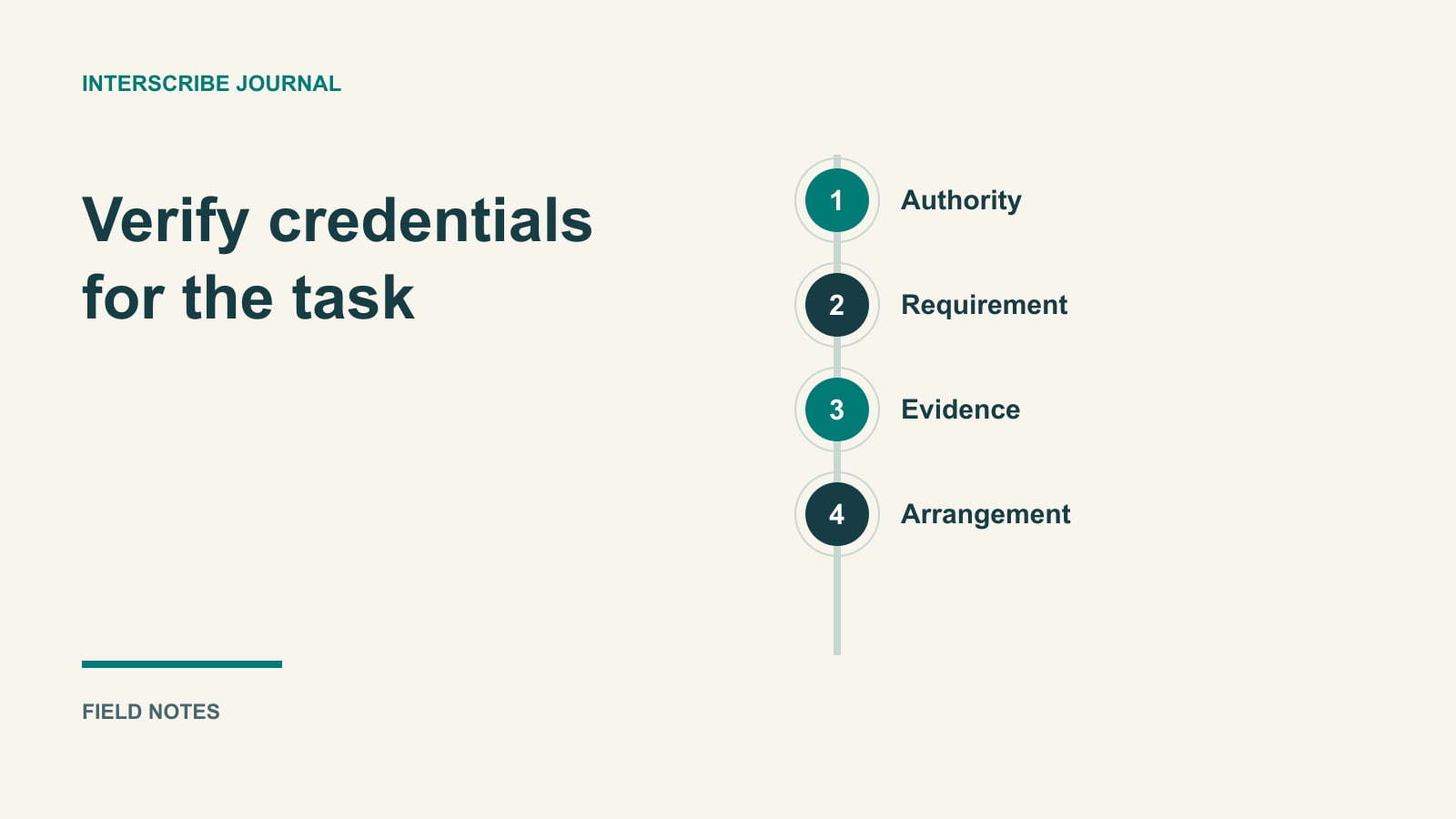
An organizer receives an interpreter's résumé with the word “certified” near the top. The booking feels settled. But certified by whom, in which language, and for which kind of assignment?
Those questions matter more than the label alone. A qualification recognized for one court or institution may not answer another authority's requirements. A general language credential does not automatically establish competence for a particular legal proceeding.
This guide provides an administrative verification workflow. It uses the U.S. federal court system as a specific example of why categories matter; it does not prescribe requirements for every court, country, arbitration, or workplace investigation. The responsible court, agency, counsel, or institutional authority must settle the rules for the actual assignment.
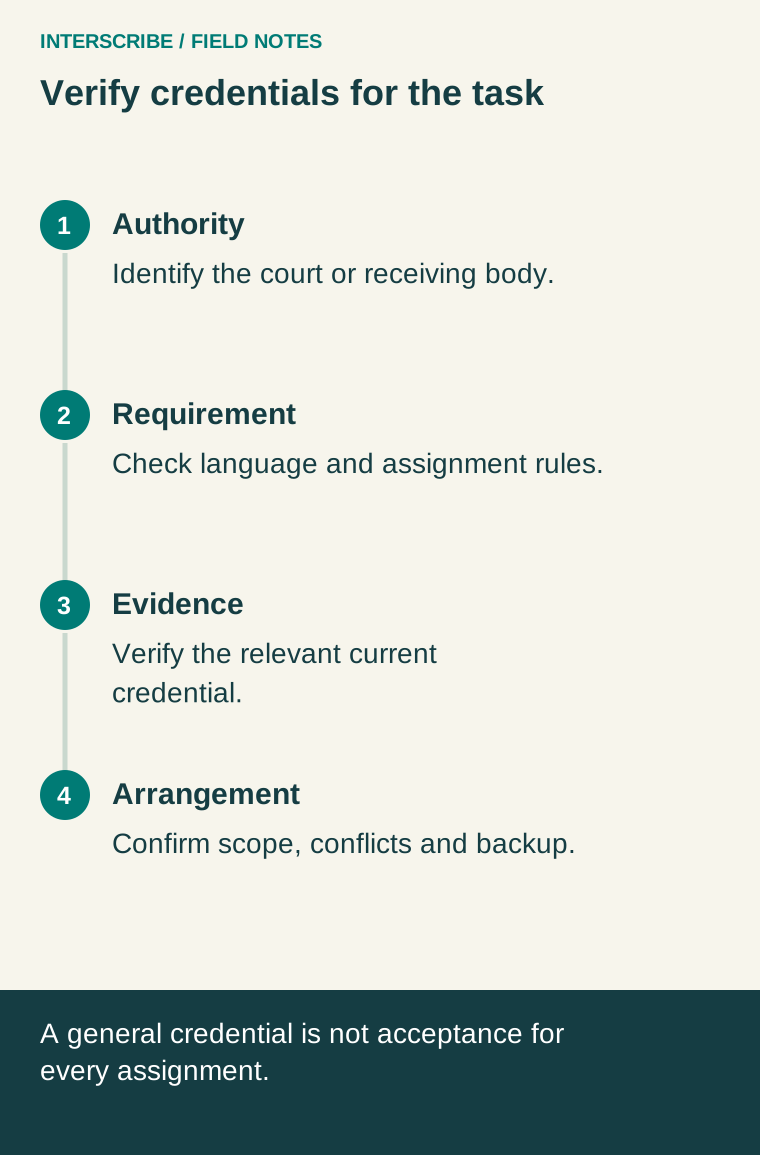
Start with the authority, not the supplier
Before requesting a quote, identify who approves the language arrangement. In a proceeding, ask the relevant court or agency contact. For an internal organizational matter, involve the person responsible for its legal and procedural requirements.
Record the proceeding or meeting type, jurisdiction, languages and directions, expected duration, remote or in-person format, and participant communication needs. Do not assume the speaker's language also describes the participant's preferred language or dialect.
Ask the authority which credential, qualification category, appointment process, or approved roster applies. Also ask who handles a language for which a particular certification is unavailable. This makes the supplier inquiry specific and avoids an unnecessary search for a credential that does not exist for that assignment.
Understand the federal example without generalizing it
The U.S. Courts interpreter categories distinguish certified, professionally qualified, and language-skilled/ad hoc interpreters. The page describes the criteria and the role of the court in determining qualifications. “Certified interpreters only” is therefore an inadequate universal summary even within this example.
Use the relevant authority's current guidance and verify the person's claimed category. Do not infer that a state credential is automatically the same as federal certification, or that experience in one language establishes qualifications in another. If the documentation is ambiguous, resolve it before confirming the assignment rather than rewriting the résumé's label in your booking notes.
Build a useful verification record
| Booking question | Evidence to retain in the approved system |
|---|---|
| Who decides eligibility? | Named court, agency, counsel, or institutional contact |
| What is the assignment? | Proceeding type, format, date, languages, and interpreting direction |
| Which qualification applies? | Current authority guidance and category or credential requested |
| What does the interpreter hold? | Issuer, relevant language, identifier, and status where applicable |
| How was it checked? | Official verification route, date, and person completing the check |
| What remains unresolved? | Specific question and the authority responsible for answering it |
| Who approves the booking? | Recorded decision, scope, and any conditions |
Handle identifying documents under your organization's normal access and retention rules. A widely shared event run sheet should not become a repository of personal credential documents or sensitive case information.
A worked fictional booking
A coordinator is arranging a remote session for a court-related matter. A supplier offers someone described as a “certified interpreter,” but the résumé does not identify the credential's language or issuing organization.
The coordinator asks the responsible court contact which category and approval process apply, then requests the matching evidence from the supplier. The contact explains the required route for that language. The coordinator records the verification and obtains approval before scheduling the technical rehearsal.
The important result is a traceable decision by the proper authority. This example does not claim that the interpreter is eligible or ineligible solely because their first email lacked detail, and it does not invent a legal outcome.
Prepare the working arrangement separately
Credential verification is one task; preparation for this specific assignment is another. Confirm how authorized materials will reach the interpreter, who can answer terminology questions, what conflicts or confidentiality requirements must be addressed, and how clarification will be requested during the session.
The federal judiciary's professional responsibility guidance addresses accuracy, completeness, confidentiality, impartiality, and other duties for federal contract court interpreters. Consult the actual governing rules for your setting rather than copying a generic agreement and assuming it covers the assignment.
Agree staffing, breaks, and handoffs with the interpreter and responsible authority. Avoid treating an event-blog timetable as a professional working-condition standard.
Rehearse communication without exposing case material
Use a neutral test passage to check microphone selection, headphones, the source the interpreter hears, and the channel participants receive. Include a turn change and the agreed clarification signal. A successful technical check establishes the tested audio route, not legal suitability or interpreting accuracy for the proceeding.
Where an approved event workflow uses InterScribe, the Booth audio guide explains device and listening selection. Product instructions do not determine whether that workflow is approved for a legal assignment. Obtain that decision before placing sensitive material into any service.
Name the person who may pause for an audio failure and the person who communicates the next step. Do not improvise a switch to an unapproved platform or unqualified helper simply because a session is already running.
Keep captions and the official record distinct
A generated caption stream, an organizer's exported transcript, and an official record are not interchangeable merely because all contain text. Confirm whether recording or transcription is permitted, which system is authorized, who reviews the result, and who may access or distribute it.
Do not describe AI captions as certified interpretation or an official transcript. Equally, do not assume that an educational event is automatically suitable for a particular tool without considering its content, audience, privacy, and required accommodations.
Before closing the booking, the coordinator should be able to name the approving authority, the verified qualification, the prepared communication route, the interruption procedure, and the approved record-handling process. That is a stronger administrative handoff than a folder containing a résumé and an unchecked promise of certification.