
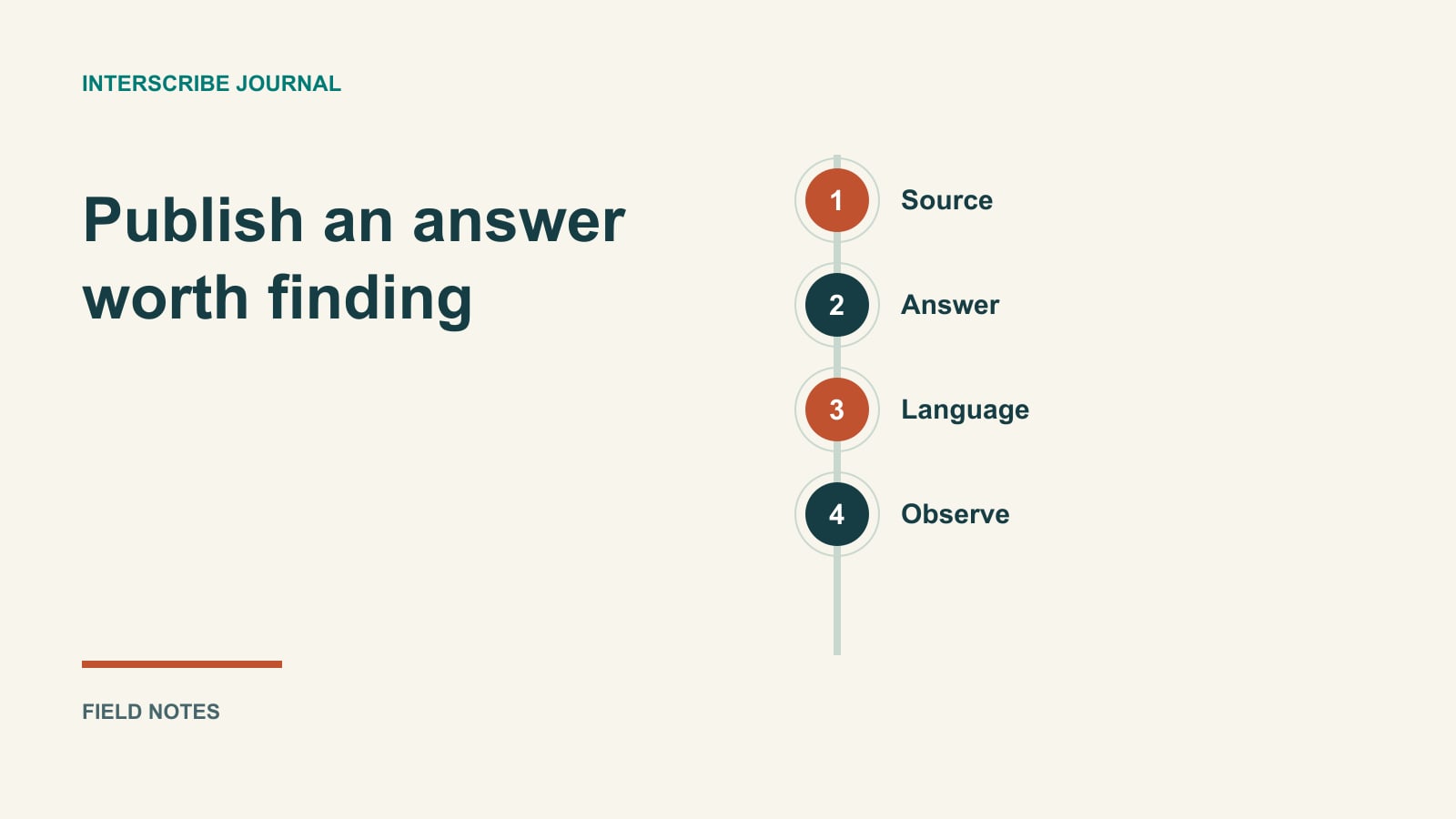
Give the reader an answer worth finding
A webinar transcript can contain an excellent explanation buried among introductions, repeated questions and references to slides the reader cannot see. Translating the raw text may reproduce those problems in another language.
The editorial opportunity is to create a useful answer for a particular audience, then prepare a reviewed language version of that answer. This guide covers the workflow from approved source material to publication and measurement. It does not promise higher rankings, traffic or sales from adding languages.
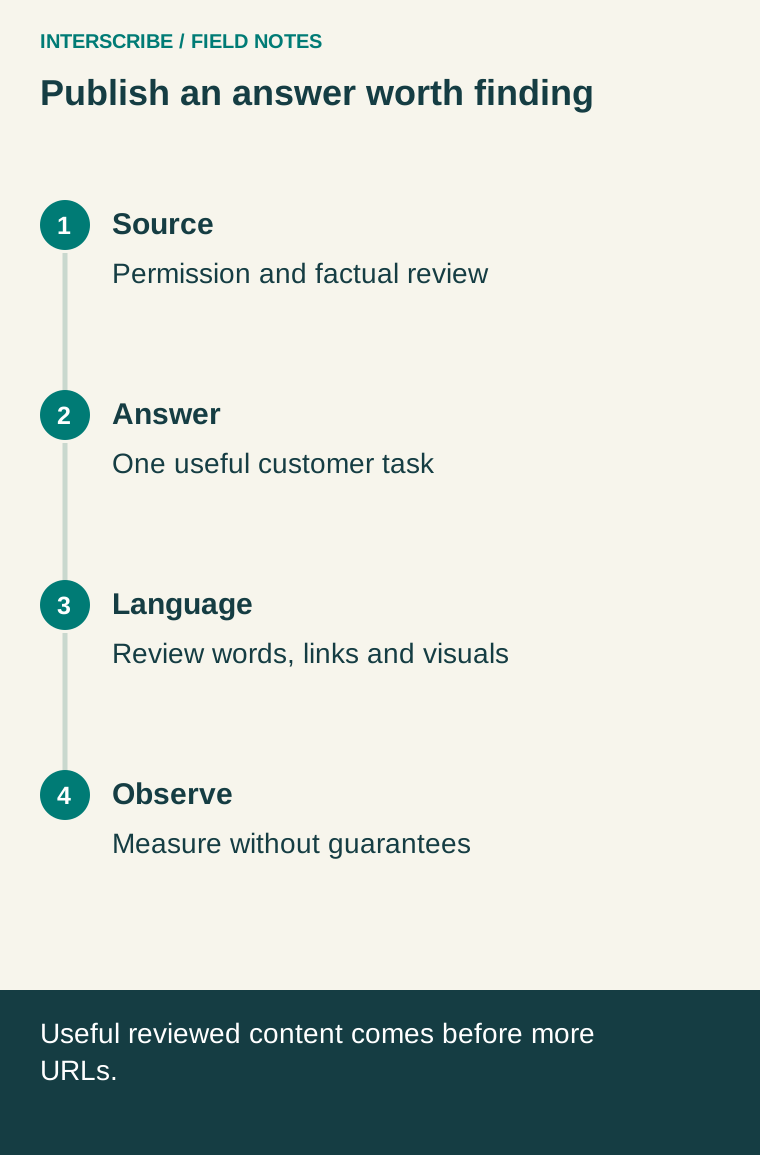
Choose one question and one audience
Start with a question customers actually ask: for example, how to test audience audio before a training session. Gather evidence from appropriate support themes, event questions or direct customer conversations without exposing private details.
Decide what the reader should be able to do afterward. A page that helps an organizer complete a rehearsal is easier to evaluate than a broad essay about the importance of communication. Ask whether the intended audience would find it useful if they arrived directly rather than through a search engine.
Google's helpful-content guidance emphasizes value for people. It also explicitly rejects adding or removing large amounts of content merely to make a site appear fresh. Preserve honest dates; a date change without a substantive revision is not an editorial improvement.
A fictional transcript-to-guide example
A fictional training company has permission to reuse a product webinar. The transcript contains an eight-minute answer about checking the correct audio source, interrupted by a connection problem and a customer's identifying details.
The editor chooses the task “Confirm that participants hear the intended source.” The finished guide will explain the check, show a simple routing diagram and provide a result sheet. The editor removes private details, verifies the control names and asks the presenter to clarify an ambiguous instruction.
A Spanish-language reviewer then adapts the guide for the intended readers. They check terminology, instructions, link destinations and the explanation attached to the diagram. The team publishes only after the source owner and language reviewer approve the final version.
| Raw material | Editorial decision | Reader benefit |
|---|---|---|
| Repeated spoken explanation | One ordered procedure | Reader can follow the task |
| “Use this setting here” | Name the verified control and its context | Instructions stand alone |
| Customer-specific example | Permission-cleared fictional scenario | Useful example without private details |
| Unexplained diagram | Add labels and a text explanation | Meaning survives outside the webinar |
This is an invented workflow example, not a report of search performance.
Review before translating at scale
Check names, quantities, technical assertions and links against current sources. A transcript is evidence of what was said, not proof that the speaker's claim is correct. Remove unsupported outcomes rather than translating them more elegantly.
Make the source article coherent before commissioning additional versions. Keep a record of the approved source revision and the reviewer for each language. If the source changes later, identify which passages need another language review.
Treat automated translation as an input to the editorial process where appropriate, not as evidence that the page is ready. Ask a qualified reviewer to complete the instructions using the published language. A grammatical translation can still direct someone to the wrong control or use an unfamiliar term for the intended audience.
For transcript retrieval, InterScribe documents language-specific exports. Export availability does not grant publication rights or confirm factual accuracy. Verify the actual account workflow and your organization's permission to reuse the material.
Give language versions a clear technical home
Google recommends separate URLs for language versions. Give readers a visible way to switch languages and ensure the main content, title and navigation make sense in the chosen language.
For corresponding versions, have the site's technical owner implement and inspect localized-version annotations. Google's hreflang guidance includes references to each version, including itself, and reciprocal links between versions. Do not declare versions that are missing or unfinished.
Canonical selection is a separate concern. Google's canonical guidance says that when using hreflang, the canonical should be in the same language, or the best substitute when none exists. Do not automatically point every translated article's canonical to English.
These are publication checks for your website team, not a claim that every site or InterScribe deployment already implements this configuration. Verify the rendered pages and technical output before marking the work complete.
Use a publication worksheet
| Gate | Evidence to keep |
|---|---|
| Audience and task | Customer question and what the page helps someone do |
| Source permission | Approved material, exclusions and responsible owner |
| Factual review | Sources for claims and resolved terminology questions |
| Language review | Reviewer, source revision and task walkthrough result |
| Visual review | Correct labels, useful alt text and legible small-screen view |
| Technical review | Live URLs, language links, annotations and canonical inspection |
| Maintenance | Correction contact and trigger for reviewing changed facts |
A useful image should explain something the text alone makes difficult: a route, comparison, sequence or completed example. Avoid translating labels into an image without also supplying the information in readable text.
Measure relevance, not a promised uplift
Choose a review window and record what was actually published. Review search queries, impressions and clicks for the relevant pages alongside a reader action that matters, such as opening the worksheet or finding the next instruction. Interpret each measure according to the tool's definition.
A higher click count after publication does not isolate the effect of translation. Campaigns, seasonality, indexing and changes to the source page may also have changed. Small numbers can move sharply. Record these limitations instead of announcing a causal return on investment.
If readers arrive but cannot complete the task, improve the page. If a language version has little observed traffic, investigate discovery and audience relevance before assuming the language is unnecessary. The durable outcome is a maintained, reviewed answer that serves a real reader; search visibility is something to observe, not guarantee.