
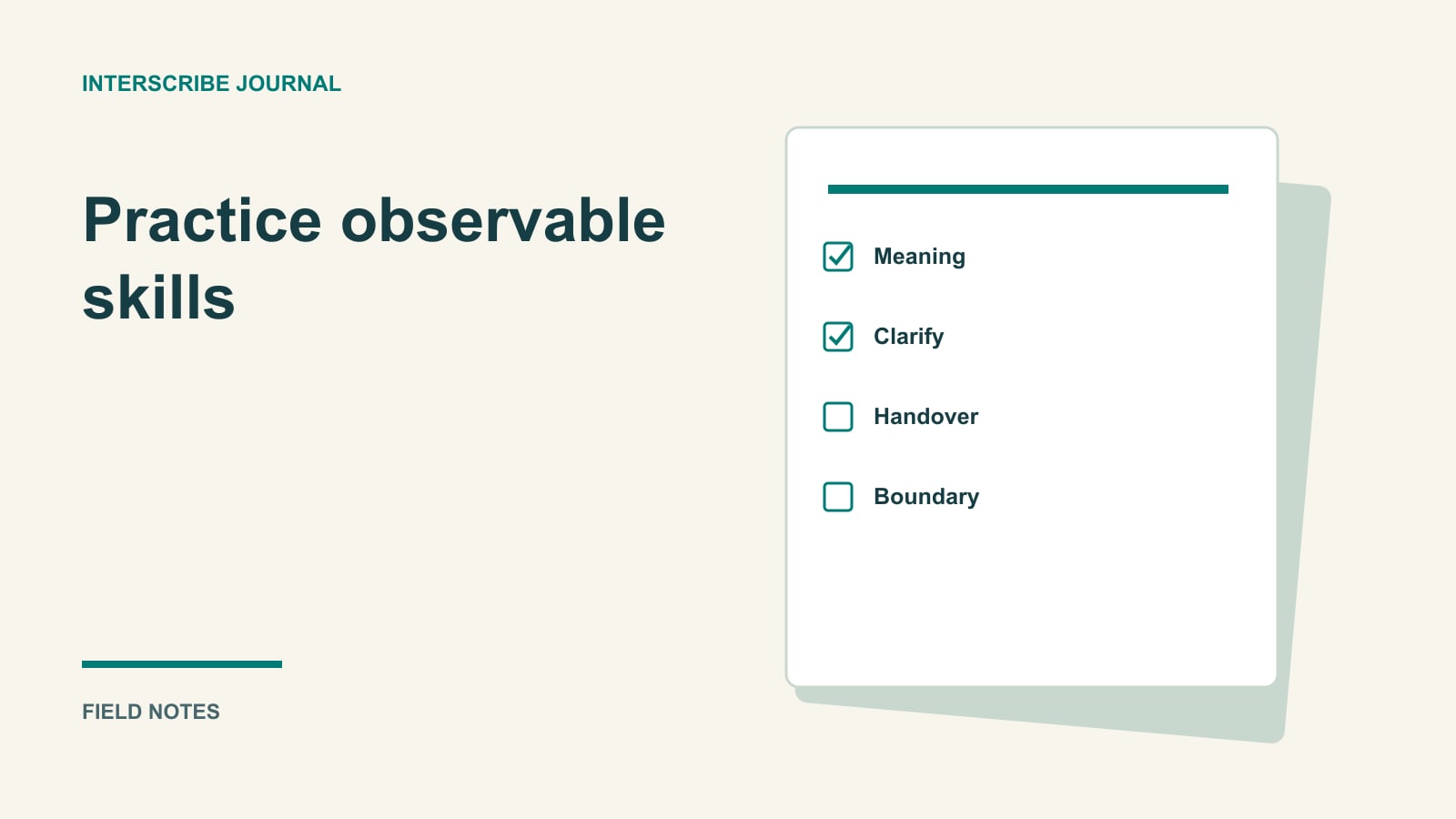
Bilingual ability is a starting point, not an assignment decision
Use the printable church language rehearsal pack to complete a volunteer role card, trace the audio path, review terms and practise the guest help script with your team.
A volunteer may be comfortable in two languages and still be unfamiliar with interpreting a fast discussion, preserving a negative or handling an unknown term without guessing. Training should make those tasks visible and give the volunteer useful feedback.
This guide is a practice framework for coordinators, not a certification program or a declaration that volunteers are suitable for every setting. Decide the assignment's requirements with an appropriately qualified person. Where a professional qualification, institutional approval or other requirement applies, route the work through that authority; completing these exercises does not replace it.
Define the role before recruiting for it
Describe the activity, language direction, format, subject matter and expected responsibilities. Interpreting a prepared community announcement is different from supporting a confidential, consequential conversation. Do not let an informal role expand because someone happens to be available.
Name the person who can assess the relevant language and interpreting performance. A coordinator who does not understand the target language cannot validate meaning simply because the delivery sounds confident. Arrange competent review and a supportive way for a volunteer to say that a task is outside their capability.
The AIIC professional framework is a useful reference for the distinction between professional standards and informal language ability. This local practice plan is not an AIIC qualification or endorsement.
Prepare safe, useful practice material
Use fictional or permission-cleared material. Tell volunteers who will hear a practice recording, what feedback it will support and when it will be deleted under the group's agreed policy. Do not use a private pastoral, medical or workplace conversation as convenient training material.
Choose short excerpts that resemble the intended task, including names, numbers, conditions and natural questions. Give the reviewer the source and the intended meaning. Include one deliberately unclear phrase so the exercise rewards asking for clarification rather than pretending to know.
Agree that mistakes during practice are information for training. The purpose is to decide the next supported step, not to rank volunteers publicly or reward uninterrupted speech over accuracy.
Four exercises with observable feedback
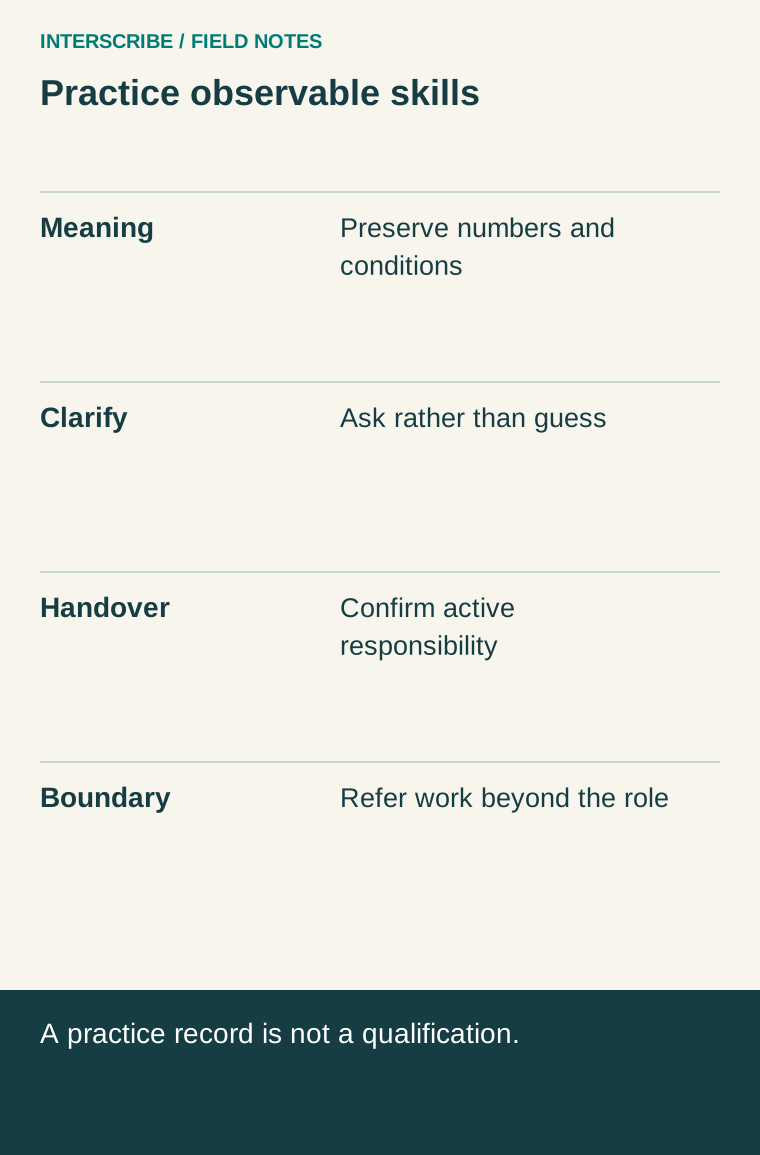
| Exercise | Fictional prompt | What the reviewer observes |
|---|---|---|
| Preserve meaning | “The meal starts at six, not seven; children enter with an adult.” | Time, negative and condition remain intact |
| Clarify uncertainty | “Meet at the usual entrance,” without naming it | Volunteer identifies the missing information and requests clarification |
| Handover | A partner is meant to take the next segment | Both confirm who is active; no silent assumption of coverage |
| Recognize a boundary | A guest asks for help with a confidential legal document | Volunteer refers the request through the coordinator's appropriate route |
The prompts are fictional and should be adapted to the actual assignment. They are not a universal test battery or proof of competence after one successful attempt.
Ask for feedback in specific terms: “The time was preserved, but the condition about an adult was omitted.” Then repeat a different example testing the same skill. Repeating the identical sentence from memory alone can hide the difficulty the training is meant to address.
A fictional church welcome-team practice
A fictional church wants volunteers to help with a supported welcome announcement at a community meal. The coordinator agrees the limited role, recruits a competent language reviewer and provides the announcement beforehand.
During practice, one volunteer interprets the start time correctly but omits that families should use a particular entrance. Another volunteer asks which entrance the speaker means before continuing. The reviewer treats that clarification as useful behavior, not a failure to appear fluent.
The coordinator keeps the first volunteer in supported practice and arranges another exercise focused on conditions. The second volunteer continues assessment for the defined announcement role. Neither is automatically assigned to private pastoral counseling because they completed an announcement exercise.
| Practice record | Fictional entry |
|---|---|
| Assigned task | Supported welcome announcement only |
| Strength observed | Time and main invitation preserved |
| Repair needed | Entrance condition omitted |
| Next exercise | Different announcement with a location condition |
| Support before assignment | Reviewer check and agreed coordinator contact |
| Boundary | Other conversations referred for an appropriate arrangement |
This record tells the volunteer what to practice and tells the coordinator what has—and has not—been assessed.
Teach the working relationship
Practice asking the speaker to pause or repeat. Agree how an interpreter signals an unclear term, missing audio or a need for relief. Tell the host that these signals are part of the plan, so the volunteer is not left negotiating them in front of the audience.
Agree staffing, preparation and breaks for the actual assignment with the people responsible for the service. Do not copy a rotation interval from a blog and call it universally safe. A partner monitoring and helping is not necessarily on a break.
Keep technical support responsibilities explicit. A volunteer interpreting the announcement should know who handles participant joining problems. Confidence with a phone or browser does not mean that person can simultaneously run the sound system, interpret and manage the help queue.
Rehearse the controls without confusing them with competence
For an InterScribe booth, the documented microphone and headphone setup includes private sound checks and floor or relay listening choices. Practice the configured path with a trainer, then verify the actual environment and permissions.
Ask the volunteer to identify what they are hearing and whether their microphone is active. Rehearse a failed handover and the agreed support contact. A successful equipment check confirms a technical task; it does not establish language accuracy or professional readiness.
Keep the audience's experience in the rehearsal too. A competent reviewer should listen from the intended receiving path rather than assessing only the volunteer's local microphone signal.
Use an assignment decision sheet
Record the role, material used, reviewer, observed strengths, unresolved issues and next practice task. End with an explicit decision: further practice, supported participation in a defined role, or referral to an appropriately qualified service. State any supervision or restrictions plainly.
Invite feedback from the volunteer after the assignment. Ask what exceeded the agreed role, what preparation was missing and what should change. Give them permission to decline a future task without having to justify it publicly.
The useful outcome is not a generic “trained” badge. It is a supported person with a clear role, observed preparation, an appropriate reviewer and a reliable route for clarification or help.