
A speaker at a healthcare education session uses an abbreviation that means one thing in their specialty and something different to the audience. The captions spell it correctly. The translated words look fluent. Yet the meaning remains unclear.
That is why reviewing medical language involves more than counting misspelled words. Organizers need to know who checks meaning, who can clarify an uncertain statement, and what happens before generated material is shared.
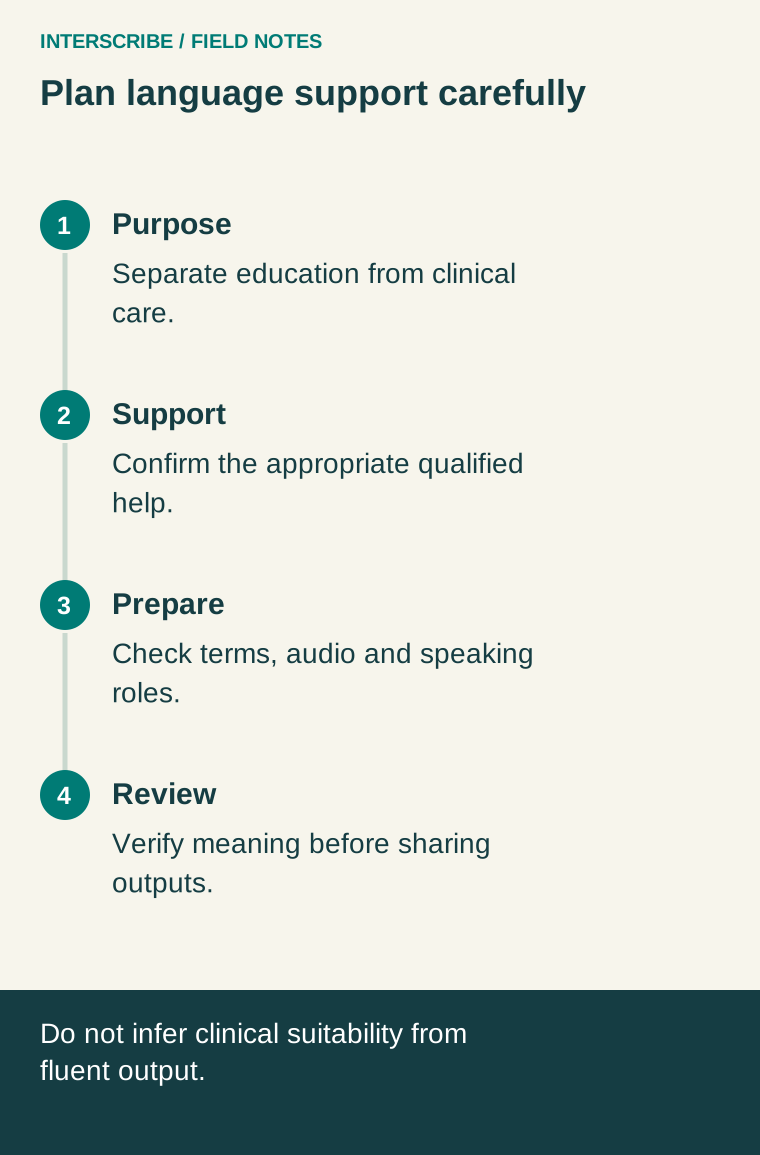
This guide focuses on preparing healthcare education events and conferences. It does not establish a clinical interpretation protocol or decide whether a particular tool satisfies an institution's legal obligations. Patient care, consent, and individual clinical advice belong under the organization's qualified language-access and clinical processes.
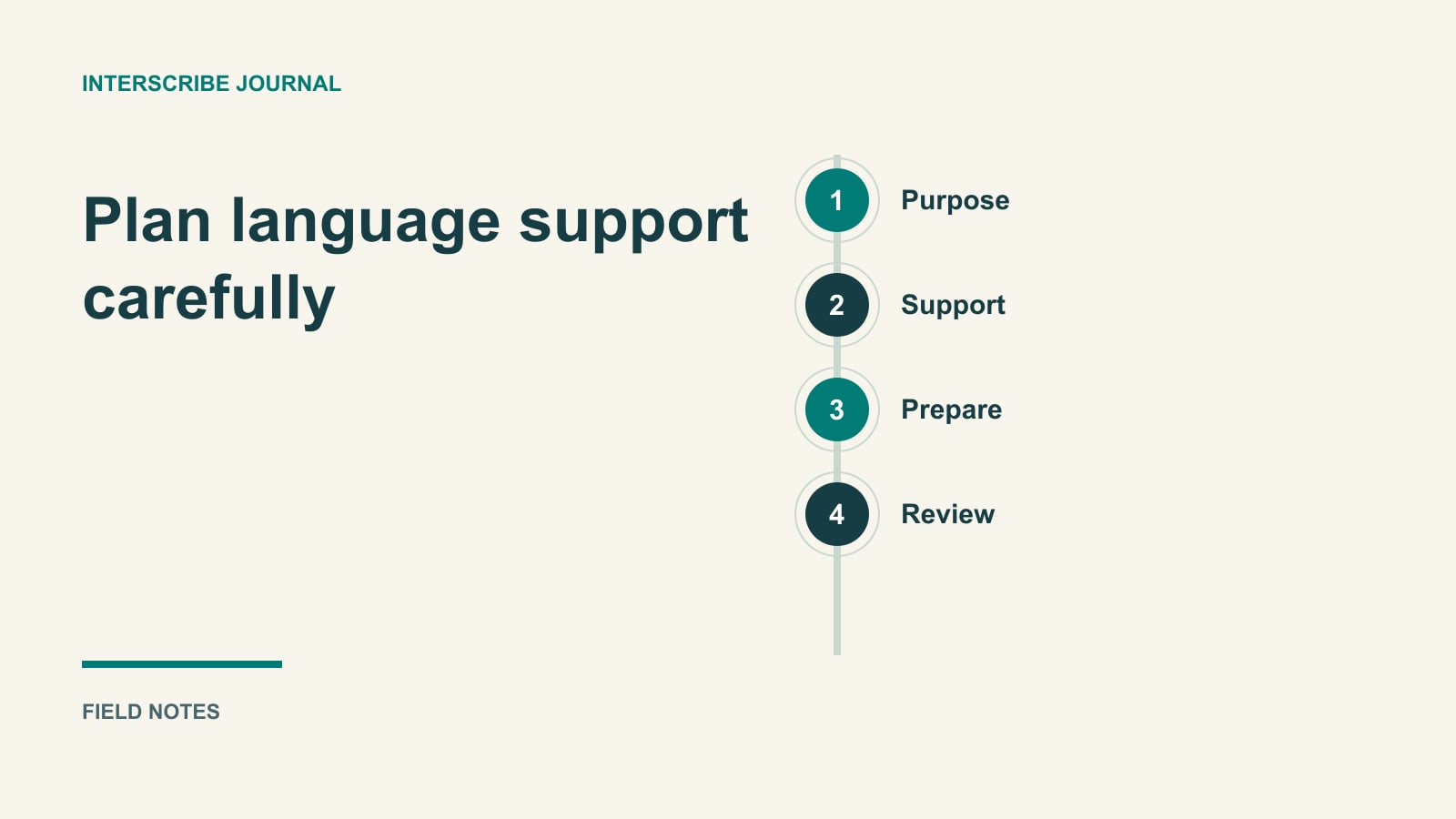
Define the communication before choosing the tool
Start with what participants will do. Listening to a research presentation, asking a general question, and discussing an individual's treatment are different activities. A session described as education can still receive a personal clinical question during Q&A.
Write down the intended audience, subject, language needs, participation format, and boundary for individual questions. Give the moderator a private referral route for matters outside the event's scope. Do not invite participants to post medical histories in a public question feed.
Assign an organizational language-access lead to confirm the appropriate arrangements. A bilingual colleague's willingness to help is not, by itself, evidence of interpreting competence. HHS's dated December 2024 language-access guidance distinguishes demonstrated interpreter qualifications from self-identified language proficiency. That guidance also discusses human review of certain machine-translated materials and notes that legal provisions may be affected by court orders. Use the responsible institutional expert to confirm current requirements for your setting; this event guide is not a compliance determination.
Prepare meaning, not only spelling
Ask the presenter for the terms that carry the argument: study names, specialist abbreviations, outcome measures, and words used differently across disciplines. A spelling list is useful, but a definition and an example sentence give reviewers much more to work with.
Separate three questions:
- Recognition: Did the text capture what the speaker actually said?
- Translation: Does the other-language version preserve that meaning?
- Content: Is the speaker's statement itself correct and appropriate for this audience?
A language reviewer may identify an ambiguity without being authorized to resolve the underlying clinical question. Keep the presenter or subject specialist involved. Conversely, subject expertise alone does not establish proficiency in the target language.
Use a terminology review worksheet
| Field | What the team records |
|---|---|
| Source term or phrase | Exact wording expected in the presentation |
| Intended meaning | Presenter-approved explanation in this context |
| Ambiguity | Other meanings, abbreviations, or easily confused wording |
| Language review | Proposed wording checked by a competent reviewer |
| Rehearsal observation | What was actually heard, captioned, or interpreted |
| Correction owner | Person who can clarify meaning or correct source material |
| Sharing decision | Whether the follow-up text is approved, pending, or excluded |
Keep the worksheet free of unnecessary patient information. Follow your organization's approved process for sharing preparatory materials with external reviewers or interpreters.
Where InterScribe preparation options are available, use the custom vocabulary workflow for supported terminology inputs. Supplying vocabulary is preparation, not a guarantee that a word will be recognized or translated correctly every time.
A worked fictional example
A continuing-education seminar discusses a fictional research project. The presenter repeatedly says “positive result.” One reviewer understands that as a favorable outcome; the presenter means that the study met a specified statistical test.
Before the event, the team records the intended meaning and asks the presenter to use a fuller phrase at the first occurrence. During rehearsal, a language reviewer checks the explanation in context, not merely whether the word “positive” appears in the output.
After the event, the summary still needs review. If it says that the project improved patient outcomes when the talk made a narrower methodological claim, the editor returns the passage to the presenter. Fluent wording does not make the conclusion accurate.
This is an illustrative review exercise, not a report of a customer result or advice about interpreting a medical test.
Rehearse the real audio and the question process
Use the actual microphone and event setup. Have a tester listen from the attendee route while the presenter reads a representative passage, including a number, a negation, and a specialist term. Test the audience microphone or moderated question route as well.
InterScribe's audio preparation guide explains source selection and testing. Establish that the correct sound arrives before attributing every caption error to terminology. A moving input meter does not establish that speech is intelligible.
Agree on a clarification procedure. The moderator can ask the presenter to restate a complete thought, and the language team should know how to flag uncertainty through the agreed channel. Do not conceal an unclear term by substituting a confident guess. If an interaction becomes clinical or individual, use the prearranged institutional route.
Review follow-up materials before release
An automatically produced transcript or summary is a draft for this workflow. Check specialist terms, names, numbers, negation, attribution, and the difference between a finding and an interpretation. Identify the version of the presentation used for review so later edits do not silently change the reference.
The summary workflow documents editing where the feature is available. Rewriting a generated summary can replace earlier edits, so preserve the approved process and verify the final distributed version.
Record the reviewer, unresolved passages, approved audience, and release decision. Do not describe an event transcript as a clinical record, certified translation, or proof of compliance merely because it can be downloaded.
A useful outcome is concrete: participants receive prepared language support, uncertainty has a clear route to a responsible person, and follow-up material is checked before people rely on it. None of those responsibilities disappears when the text looks polished.