
A fluent sentence can still need checking
Machine translation can produce readable output while selecting a meaning the speaker did not intend. For an event organizer, the useful question is not whether the system sounds intelligent. It is what information the system received and how the team will check the meaning that matters.
This guide explains a few concepts behind neural machine translation, then turns them into a practical review exercise. It is a conceptual explanation, not a disclosure of InterScribe's model architecture, provider contracts, training data or settings.
What “neural” explains—and what it does not
At a high level, neural translation systems use learned numerical representations and patterns to produce target-language text conditioned on input. They do not work like a simple list that replaces each source word with one fixed counterpart.
The research paper Attention Is All You Need introduced the Transformer architecture, using attention mechanisms and evaluating it on translation tasks. That is an important technical reference, not proof that every translation service uses the same architecture or behaves the same way.
For a reader planning an event, the practical implication is narrower: context can influence a translation, and the amount and form of context available in a particular system matters. Ask about the actual service you are evaluating rather than inferring capabilities from the general label “AI.”
A fluent result is not a verification step. It must still be compared with the intended source meaning, especially when a negative, condition, name or quantity changes what someone would do.
A fictional ambiguity exercise
Imagine a fictional English-language talk containing the sentence “Meet me by the bank.” A reviewer cannot confidently select the intended Spanish wording without knowing whether the speaker means a financial institution or a riverside location.
The next sentence, “The footpath runs beside the river,” changes the available context. It does not create a guarantee about any particular system's output. It gives the reviewer and the source speaker a concrete ambiguity to resolve.
Now consider a different sentence: “Do not approve the transfer.” If the recognized source text omits “not,” the translation stage receives a different instruction. Correctly translating that wrong input would still mislead the listener.
| Test item | Problem to distinguish | Appropriate review action |
|---|---|---|
| “Meet me by the bank” alone | Source meaning is ambiguous | Ask for context rather than guessing |
| Same sentence with river context | Relevant context is now available | Check whether target meaning reflects it |
| Negative missing from recognized text | Upstream recognition changed the message | Compare audio and source text first |
| Correct source, wrong target meaning | Translation choice needs examination | Have a competent reviewer identify the mismatch |
These are constructed examples, not benchmark results or representative error rates. Their value is showing that different problems call for different evidence.
Keep three records for a useful review
Preserve the source sentence or permission-cleared audio excerpt, the text supplied to translation when available, and the target output. Add enough surrounding context to explain the intended meaning without unnecessarily sharing an entire confidential meeting.
Ask the reviewer to describe the difference in terms a non-specialist can act on. “Wrong” is not enough. “The target text removes the condition that approval must happen first” identifies the information that needs repair.
Where the source itself is unclear, the speaker or content owner should resolve it. A language reviewer should not be expected to invent the missing fact. For consequential decisions, use the organization's approved source and review process rather than treating an unreviewed live rendering as authoritative.
Test terminology controls as a feature, not a promise
A product may offer vocabulary, glossary or contextual controls, but those words can describe different mechanisms. Ask where the control acts, which language it applies to, what its limits are and how to verify its effect.
InterScribe's glossary and context documentation describes vocabulary rules and selecting a vocabulary in the session's Captions & translation settings. That is documentation of a configuration workflow, not proof of perfect term handling or permanent learning from every session. Confirm the available controls in the actual environment and compare repeatable examples before and after a change.
Include a sentence where the term is intended and another where a similar expression has a different meaning. A rule that helps one prepared sentence could introduce an unwanted result elsewhere. Keep the test small enough that the reviewer can inspect every example rather than relying on a favorable average.
Use this meaning-check worksheet
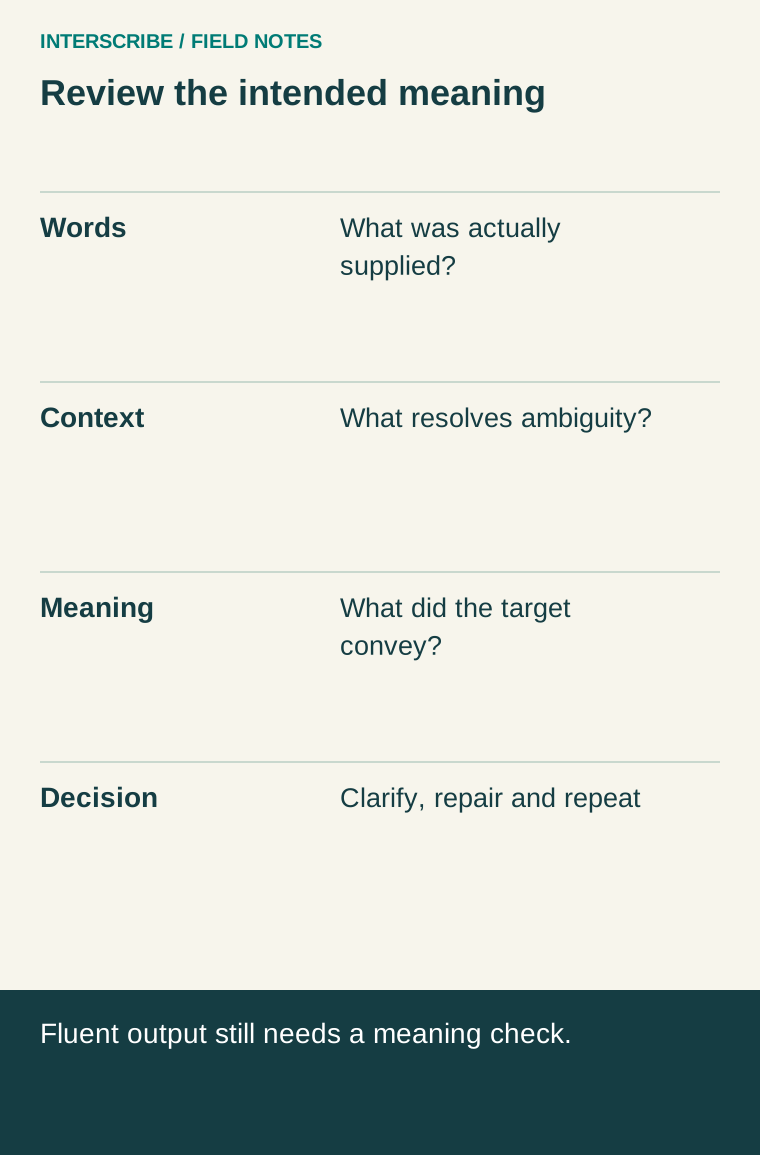
| Field | What to record |
|---|---|
| Task | What the listener needs to understand or decide |
| Source and context | Exact sentence plus the minimum relevant surrounding information |
| Intended meaning | Speaker-approved explanation of the key fact or instruction |
| Recognized text | Any difference between audio and the text passed onward |
| Target output | Language, observed wording and configuration used |
| Review finding | Preserved meaning, ambiguity, omission, addition or wrong term |
| Repair and repeat | Source clarification or authorized change, followed by the same test |
Keep the result categories descriptive. A short internal exercise should not be advertised as an accuracy percentage for all languages, speakers or topics. Record who reviewed the output and why they were suited to the subject and language pair.
Evaluate the experience as well as the sentence
The right words arriving after the discussion has moved on may not support the intended task. Test timing separately from meaning and state exactly what you measured. Avoid borrowing an isolated provider processing figure as an end-to-end audience guarantee.
For live troubleshooting, the sentence-trace guide follows audio, recognition, translation and audience delivery. This article's worksheet instead focuses on the meaning decision: what was known, what was ambiguous and who can resolve it.
The result is a more useful conversation with a vendor or production team. You can show a concrete example, explain the intended meaning and ask a bounded question about the actual configuration. That is stronger evidence than either assuming fluent text is correct or assuming one failed sentence proves the whole technology unusable.